Anyone researching this trek quickly runs into a handful of route variations, but the Everest Base Camp trek classic route remains the most popular for good reason. It is the original, time-tested path through the Khumbu that balances scenery, cultural exposure, and manageable acclimatization better than any of the shortcut or alternate options.
At We Ramblers, the classic route is what we recommend to the vast majority of first-time trekkers. This guide breaks down exactly what that route looks like, how long it takes, where it starts, a full day-by-day schedule, and what it costs, including a clear breakdown in rupees for trekkers coming from India.
What Is the Everest Base Camp Classic Route?
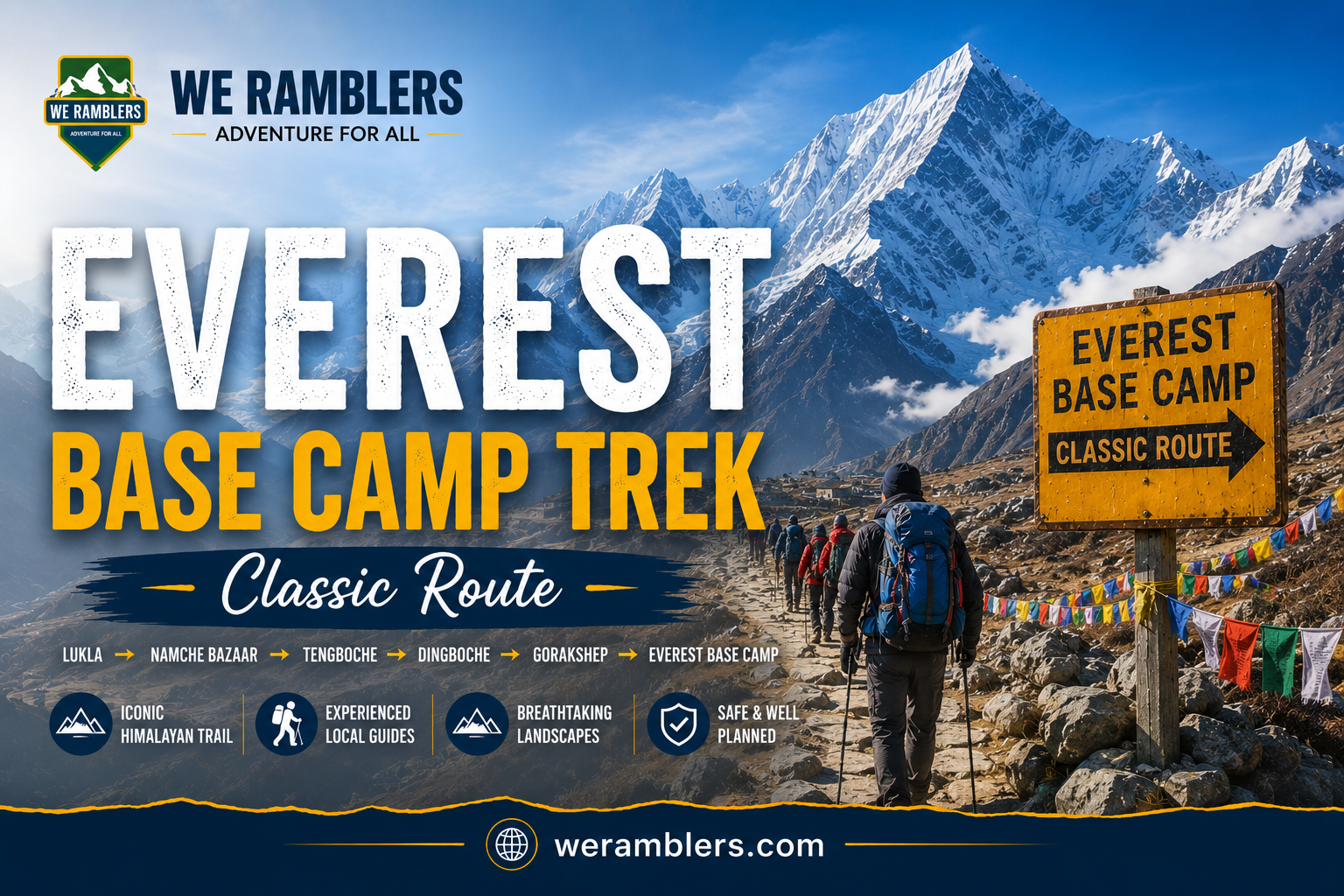
The Everest base camp classic route refers to the traditional out-and-back trail through the Khumbu Valley, following the path used by climbers and trekkers since the earliest Everest expeditions. It runs through Sagarmatha National Park via Namche Bazaar, Tengboche, Dingboche, and Lobuche before reaching Everest Base Camp and the Kala Patthar viewpoint.
This is distinct from a few alternate approaches some trekkers consider:
- The Jiri to Everest Base Camp route, a much longer classic approach that adds roughly a week of extra trekking before even reaching Lukla, following the original path used before regular flights existed
- The Three Passes trek, a far more demanding variation that loops through Kongma La, Cho La, and Renjo La passes for experienced high-altitude trekkers
- The Gokyo Lakes extension, which adds a detour to a stunning alpine lake system for those with extra time
For most trekkers, the classic route via Lukla is the right call. It offers the full Everest experience, including all the major highlights, without the extra time commitment or technical difficulty of the alternatives.
Where Does the Everest Base Camp Trek Start?
This is one of the most common questions we get, and the answer surprises some people. The trek does not begin in Kathmandu itself, though your journey does. Here is how it actually works:
You fly from Kathmandu to Lukla, a small mountain airstrip that sits at around 2,840 meters. Lukla is where the actual trekking begins. From there, the trail follows the Dudh Kosi river valley, gradually climbing through Sherpa villages toward Namche Bazaar and eventually up to Everest Base Camp itself.
Some trekkers choose to start further out, in Jiri or Phaplu, and trek in on foot rather than flying. This adds significant time and distance but follows the historic route used before Lukla’s airstrip was built. For the standard classic route, though, Lukla is your starting point.
How Long Is the Trek to Everest Base Camp?
The how long is the trek to Everest Base Camp question has a few different answers depending on what you are measuring.
In days: Most classic route itineraries run 12 to 14 days total, including flights, trekking days, and two acclimatization days. Some operators offer shorter 10 or 11 day versions by trimming rest days, though this is not recommended given the altitude involved.
In distance: The round trip covers approximately 130 kilometers (roughly 80 miles) from Lukla to Everest Base Camp and back to Lukla, including the side trip to Kala Patthar.
In elevation gain: You climb from Lukla at 2,840 meters to Everest Base Camp at 5,364 meters, with Kala Patthar reaching 5,545 meters as the highest point most trekkers stand on during the trip.
In walking hours: Daily trekking typically runs between 4 and 7 hours, with longer days around Kala Patthar and the return descent to Namche.
Trying to compress this into fewer days significantly raises the risk of altitude sickness. The itinerary length is not arbitrary, it is built around how quickly the human body can safely adjust to decreasing oxygen levels.
Everest Base Camp Trek Route Explained
The Everest Base Camp trek route follows a fairly consistent path used by virtually all trekking operators, since it is shaped by the geography of the Khumbu Valley itself. Here is the route broken into its major stages:
Lukla to Namche Bazaar: The trail follows the Dudh Kosi river through pine forests and small villages, crossing several suspension bridges before a steep climb into Namche, the unofficial capital of the Khumbu.
Namche to Tengboche: The trail opens up with your first real mountain views, passing through rhododendron forest before reaching Tengboche and its famous monastery.
Tengboche to Dingboche: The landscape shifts from forest to alpine terrain as you gain altitude, with the trees thinning out noticeably.
Dingboche to Lobuche: This stretch runs along the edge of the Khumbu Glacier moraine, with increasingly stark, high-altitude scenery.
Lobuche to Everest Base Camp via Gorak Shep: The final push crosses rocky glacial terrain to reach Base Camp itself, with Gorak Shep serving as the overnight base for this stage and for the Kala Patthar sunrise hike.
The return trip generally retraces the same path, sometimes with a minor variation through Phortse or Pangboche to add scenic variety.
Everest Base Camp Trek Classic Route Itinerary
Below is the standard 14-day schedule we build for classic route departures at We Ramblers, factoring in proper acclimatization at both key altitude thresholds.
Day 1: Arrive in Kathmandu, hotel check-in and pre-trek briefing.
Day 2: Fly to Lukla (2,840m), trek to Phakding (2,610m).
Day 3: Trek to Namche Bazaar (3,440m).
Day 4: Acclimatization day in Namche, short hike to a nearby viewpoint.
Day 5: Trek to Tengboche (3,860m).
Day 6: Trek to Dingboche (4,360m).
Day 7: Second acclimatization day in Dingboche, optional hike for altitude adjustment.
Day 8: Trek to Lobuche (4,940m).
Day 9: Trek to Everest Base Camp (5,364m), return to Gorak Shep (5,170m) for the night.
Day 10: Sunrise hike to Kala Patthar (5,545m), descend to Pheriche.
Day 11: Trek back to Namche Bazaar.
Day 12: Trek back to Lukla.
Day 13: Fly back to Kathmandu.
Day 14: Departure or extra sightseeing in Kathmandu.
This schedule includes two dedicated acclimatization days, at Namche and Dingboche, which is the minimum recommended for this altitude profile. Trekkers with extra time can add a Gokyo Lakes or Phortse extension without deviating from the core classic route experience.
Everest Base Camp Trek Schedule Considerations
Beyond the day-by-day plan, a few scheduling factors are worth thinking through before you book:
Season matters. Spring (March to May) and autumn (late September to November) offer the most stable weather, while winter and monsoon months bring their own trade-offs in cost, crowds, and conditions.
Buffer days matter more than people expect. Lukla flights are notoriously weather-dependent. Building in at least one extra day before your international departure protects you against the not-uncommon scenario of a delayed flight out of the mountains.
Fitness prep should start early. A minimum of six to eight weeks of cardio and strength training before departure makes a real difference in how comfortable the trek feels, regardless of which month you choose.
Everest Base Camp Trek Cost in Rupees
For trekkers coming from India, understanding the Everest Base Camp trek cost in rupees is often the deciding factor in planning. Indian passport holders benefit from several cost advantages that make this trek noticeably more affordable than it is for most other nationalities.
Overall package cost: Most Indian trekkers spend between INR 90,000 and INR 1,70,000 for a complete guided 12 to 14 day classic route package, depending on the operator, group size, and level of comfort chosen. Budget group departures can run as low as INR 60,000 to 70,000, while premium or private packages can reach INR 2,00,000 or more.
What drives the cost down for Indian nationals:
- No visa is required for travel to Nepal, saving both money and paperwork
- SAARC national pricing applies to permits, including a reduced Sagarmatha National Park entry fee
- Flights from major Indian cities like Delhi, Mumbai, Bengaluru, and Kolkata to Kathmandu are relatively short and competitively priced, typically ranging from INR 15,000 to 25,000 round trip
- Overland travel via border towns like Raxaul or Sunauli is also an option for those looking to cut airfare costs further, though it adds travel time
Typical cost breakdown:
- Sagarmatha National Park permit: around INR 2,000 to 2,500 for SAARC nationals
- Khumbu Rural Municipality entry permit: roughly INR 2,000, which applies to all nationalities equally
- Domestic flights (Kathmandu to Lukla round trip): included in most packages, otherwise budget separately
- Guide and porter fees: usually bundled into the package price
- Accommodation and meals on the trail: included in standard and premium packages
A word of caution on ultra-budget pricing: packages advertised well below INR 60,000 often cut corners on group size, food variety, or guide experience. Since hiring a licensed guide is now mandatory for this trek, it is worth confirming exactly what is included before booking based on price alone.
Why the Classic Route Remains the Right Choice for Most Trekkers
With so many route variations available, it is worth being clear about why the classic route continues to be the default recommendation for the vast majority of trekkers.
Proven acclimatization profile. The altitude gain pattern on this route has been refined over decades of trekking traffic, striking the right balance between progress and safety.
Full access to the region’s highlights. Namche Bazaar, Tengboche Monastery, Kala Patthar, and Everest Base Camp itself are all included without the extra time commitment of longer alternate routes.
Well-developed infrastructure. Teahouses, guides, and support services along this route are the most established in the entire Khumbu region, since it carries the highest volume of trekking traffic.
Flexibility to extend. If you want more, the classic route serves as an easy base to which you can add the Gokyo Lakes or a Three Passes extension in future trips, without needing to start from scratch.
Frequently Asked Questions: Everest Base Camp Trek Classic Route
What is the Everest Base Camp classic route?
The classic route is the traditional out-and-back trail from Lukla through Namche Bazaar, Tengboche, Dingboche, and Lobuche to Everest Base Camp and Kala Patthar. It is the most widely used and well-supported path in the Khumbu region.
How long is the trek to Everest Base Camp?
Most classic route itineraries take 12 to 14 days including flights and two acclimatization days, covering approximately 130 kilometers round trip from Lukla to Base Camp and back.
Where does the Everest Base Camp trek start?
The trek begins in Lukla, reached by a short domestic flight from Kathmandu. Kathmandu is where your overall trip starts, but the actual trekking begins once you land in Lukla.
What is the Everest Base Camp trek cost in rupees for Indian trekkers?
Most Indian trekkers spend between INR 90,000 and INR 1,70,000 for a complete 12 to 14 day guided package, with budget group options available from around INR 60,000 to 70,000. Indian passport holders benefit from SAARC permit discounts and visa-free entry to Nepal.
Is the classic route suitable for beginners?
Yes, the classic route is generally considered the most beginner-friendly path to Everest Base Camp, provided trekkers arrive with reasonable fitness and follow the built-in acclimatization schedule. It does not require any technical climbing skills.
Can I extend the classic route to include Gokyo Lakes?
Yes, many trekkers add a Gokyo Lakes detour to the classic route for an extended experience. This typically adds 3 to 4 days to the standard itinerary but follows the same general trail infrastructure.
Ready to Trek the Everest Base Camp Classic Route?
At We Ramblers, we specialize in the classic route itinerary, built around proper acclimatization, experienced local guides, and transparent pricing with no hidden costs. Whether you are trekking from India or anywhere else in the world, our team can help you plan a trip that matches your budget, fitness level, and travel dates.
Contact We Ramblers today to start planning your Everest Base Camp classic route trek, and let us handle the logistics while you focus on the adventure ahead.