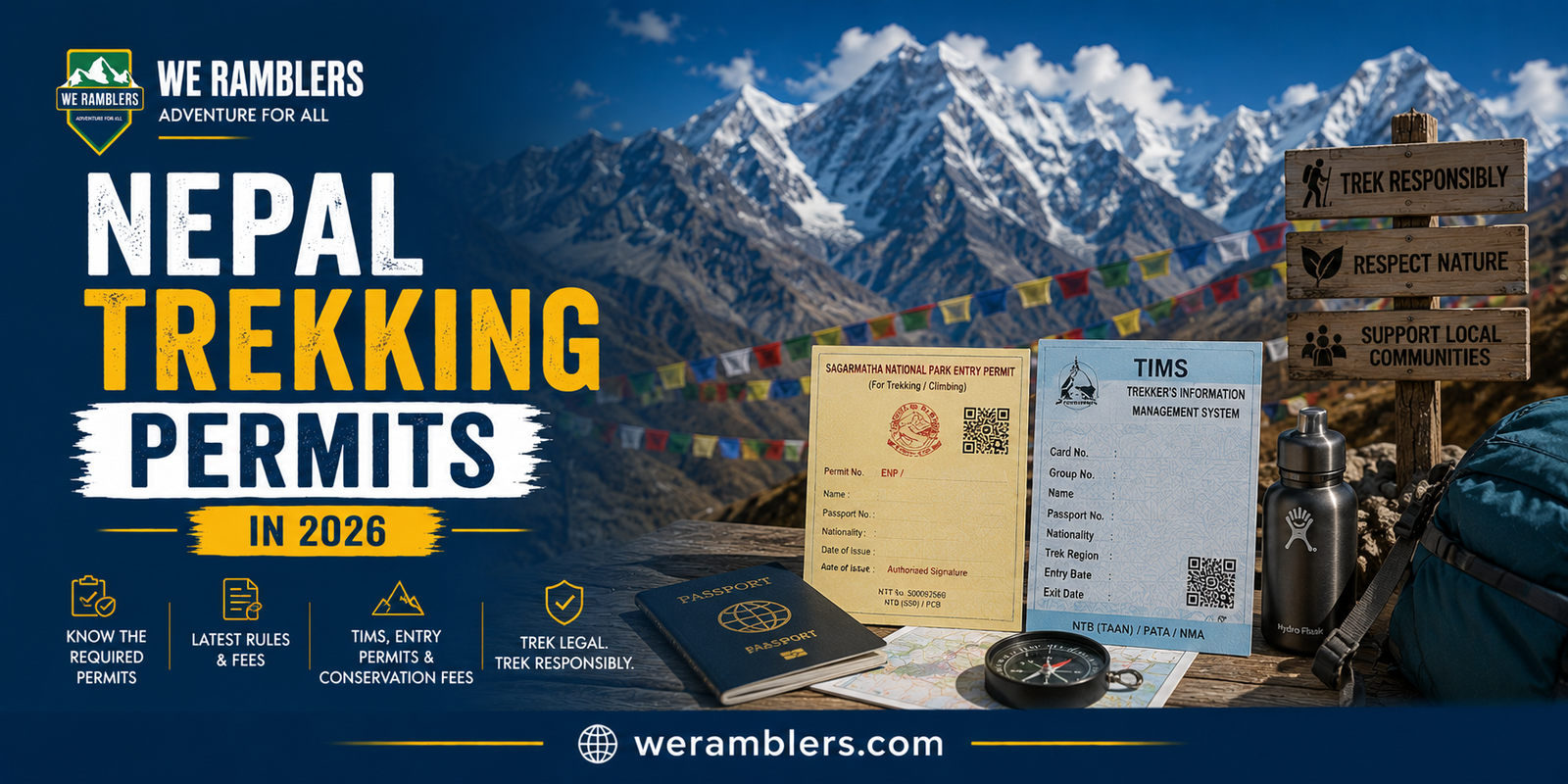
Do You Need a Permit to Trek in Nepal? Yes, and possibly more than one. Nepal’s trekking permit system is layered, and the permits required depend on which region you are trekking in. Getting this wrong means being turned back at a checkpoint, which happens more often than trekkers expect.
This guide explains every permit required for Nepal trekking in 2026, current fees, where to obtain them, and which treks require special restricted area permits.
TIMS Card: Trekkers’ Information Management System
The TIMS card is required for all trekkers visiting Nepal on designated trekking routes. It was introduced to improve trekker safety and keep a record of who is on the trail.
There are two types of TIMS card.
Green TIMS for individual trekkers costs USD 20 per person. Blue TIMS for group trekkers through a registered agency costs USD 10 per person.
TIMS cards are obtained in Kathmandu at the Nepal Tourism Board office in Pradarshani Marg or at the Trekking Agencies’ Association of Nepal (TAAN) office. You can also obtain them through a registered trekking agency.
Required documents include a passport copy, one passport-sized photo, and a completed application form.
Note: TIMS cards are checked at multiple checkpoints on all major routes. You will be turned back without one.
National Park and Conservation Area Entry Permits
In addition to TIMS, you need entry permits for whichever protected area your trek passes through.
Sagarmatha National Park (Everest Region)
Required for the Everest Base Camp Trek, Gokyo Lakes Trek, Three Passes Trek, and all treks entering the Khumbu region.
Fee: NPR 3,000 per person (approximately USD 22) for SAARC nationals; USD 30 for all others.
Obtained at the national park entrance gate in Monjo, or in advance in Kathmandu at the Department of National Parks and Wildlife Conservation.
Annapurna Conservation Area (ACAP)
Required for the Annapurna Circuit Trek, Annapurna Base Camp Trek, Mardi Himal Trek, and Ghorepani Poon Hill Trek.
Fee: NPR 3,000 per person for SAARC nationals; USD 30 for others.
Obtained at the ACAP office in Pokhara, or at the entrance checkpoint in Besisahar or Nayapul depending on your route.
Langtang National Park
Required for the Langtang Valley Trek, Gosaikunda Trek, and Helambu Trek.
Fee: NPR 3,000 per person for SAARC nationals; USD 30 for others.
Obtained at the Department of National Parks office in Kathmandu, or at the park entrance.
Manaslu Conservation Area
Required for the Manaslu Circuit Trek.
Fee: NPR 3,000 per person for SAARC nationals; USD 30 for others.
Note: The Manaslu Circuit additionally requires a Restricted Area Permit as described below.
Restricted Area Permits in Nepal
Several trekking regions in Nepal require special Restricted Area Permits (RAP) in addition to standard permits. These regions are restricted to protect fragile ecosystems and sensitive border zones. RAPs must be obtained through a government-registered trekking agency. Independent trekking without a guide is not permitted in these areas.
Upper Mustang Restricted Area Permit
Fee: USD 500 per person for the first ten days; USD 50 per additional day.
Minimum requirement: you must trek with a registered agency and a licensed guide. Independent trekking is not allowed.
Season: technically open year-round, but practically best visited from May to October. The region lies in a rain shadow and receives very little monsoon rainfall, making it one of Nepal’s few viable monsoon-season destinations.
Manaslu Restricted Area Permit
Fee: USD 100 per person per week in September and October; USD 75 per week in other months.
Minimum requirement: registered agency and licensed guide. Groups of at least two trekkers are required.
Nar Phu Valley Restricted Area Permit
Fee: USD 90 per person per week in restricted areas.
Minimum requirement: registered agency and licensed guide. This is one of Nepal’s most isolated regions.
Dolpo Restricted Area Permit
Lower Dolpo costs USD 30 per person per day. Upper Dolpo costs USD 500 per person for the first ten days and USD 50 per day after that.
Do Indian Nationals Need Different Permits?
Indian nationals are treated as SAARC nationals for all national park and conservation area entry fees, meaning they pay the lower NPR 3,000 rate rather than the USD 30 rate. This is a meaningful saving across a multi-permit trek.
However, Indian nationals do still need all the same permits as other foreigners. Visa-free entry to Nepal does not exempt Indian trekkers from TIMS or national park permits. These are entirely separate systems.
Mountaineering and Peak Climbing Permits
If your trek includes a peak climb such as Island Peak, Mera Peak, or Lobuche Peak, you need an additional peak permit from the Nepal Mountaineering Association (NMA).
Island Peak: USD 250 per person in spring and autumn; USD 125 in winter and monsoon. Mera Peak: USD 250 per person in spring and autumn; USD 125 in other seasons. Lobuche Peak: USD 250 per person in spring and autumn.
These permits are required in addition to national park entry and TIMS.
Where to Get Nepal Trekking Permits in 2026
Most permits can be obtained in Kathmandu or Pokhara before you begin your trek. For restricted area permits, you must use a registered trekking agency since they handle the paperwork on your behalf.
Do not rely on obtaining permits at remote checkpoints. Some checkpoints issue permits on-site but this is not guaranteed, and showing up without the correct documents wastes time and creates unnecessary stress at the start of a long trek.
Always carry physical copies of all permits. Checkpoint officials stamp your permits at each post, and this is how the system tracks trekker movements and enables search and rescue operations when needed.
Let We Ramblers Handle Your Nepal Trekking Permits
Permits are one of the most confusing parts of planning a Nepal trek, particularly when multiple regions, restricted zones, and peak climbing permits overlap. We Ramblers takes care of the entire permit process on your behalf as part of every trek package.
As a government-registered Nepal trekking agency with offices in both Kathmandu and Bengaluru, We Ramblers is fully authorised to process TIMS cards, national park and conservation area entry permits, and restricted area permits for Upper Mustang, Manaslu, Nar Phu Valley, and other controlled zones. You do not need to visit multiple offices, fill out forms separately, or worry about which checkpoint requires which document. The team handles it all before your trek begins.
To find out which permits apply to your chosen route and get everything sorted before you fly, visit weramblers.com or contact the team directly through the India or Nepal office.