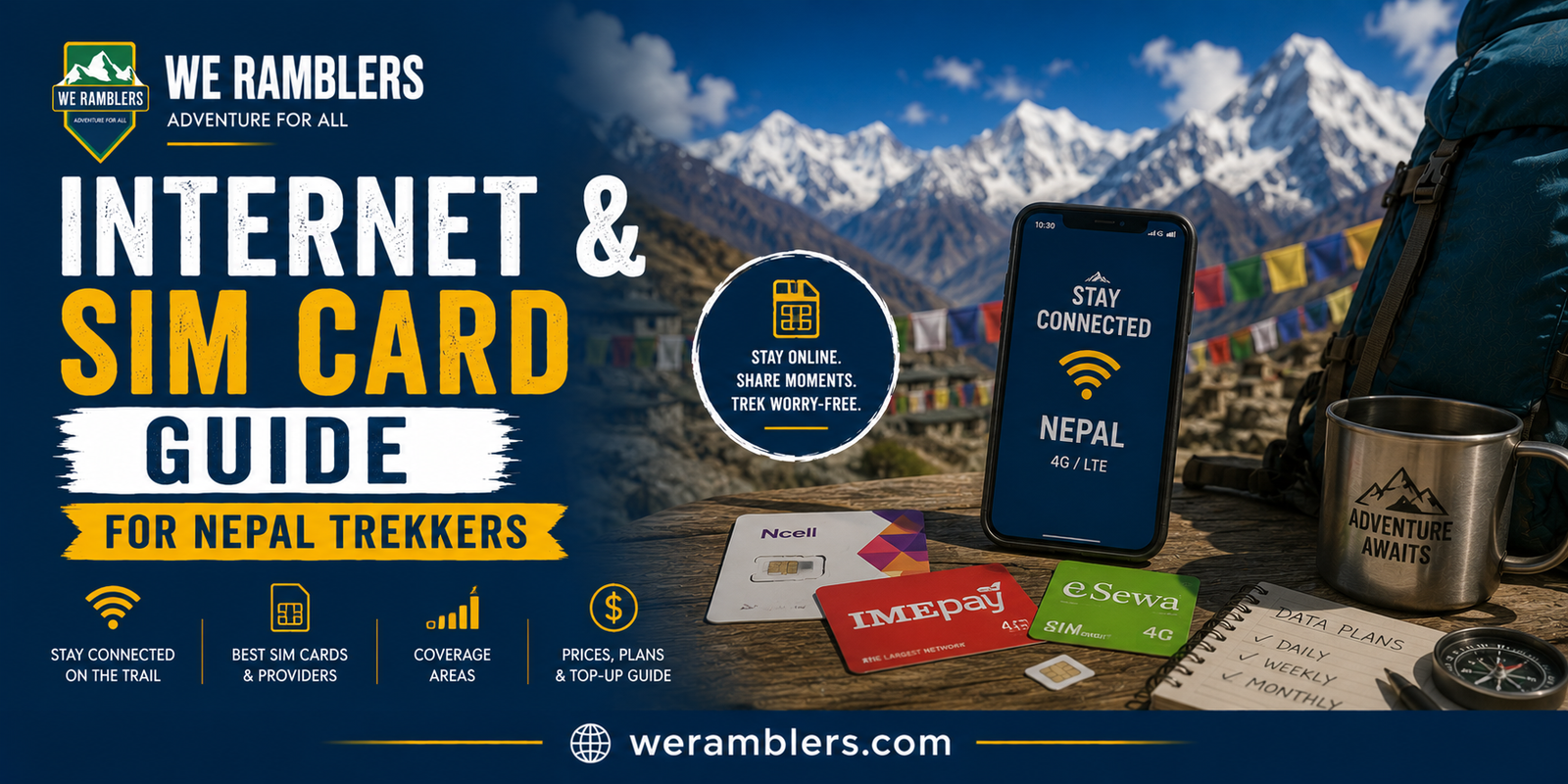
One of the most common questions from trekkers planning a Nepal adventure is how to stay connected on the trail. The answer in 2026 is better than it was five years ago, but it still requires planning. Mobile coverage on Nepal’s major trekking routes has improved significantly, though you will still encounter long stretches without any signal, and connectivity speeds vary enormously by location.
This guide covers the best SIM cards for Nepal trekking, how to buy one, which apps to download before you leave, and where you can realistically expect a signal on the trail.
Which SIM Card Is Best for Nepal Trekking?
Nepal has two major mobile network providers: Ncell and Nepal Telecom (NTC). Each has different strengths on the trail.
Ncell
Ncell is Nepal’s largest private telecom operator and uses a 4G LTE network in urban areas and lower-altitude trekking zones. Coverage along the popular Annapurna Circuit and lower sections of the EBC route up to Namche Bazaar is generally reliable with an Ncell SIM.
Above Namche Bazaar and in more remote regions, Ncell coverage becomes patchy and often disappears entirely. In Upper Mustang, Nar Phu Valley, and Dolpo, Ncell coverage is minimal or absent.
Data packages are affordable: 20GB of data costs approximately NPR 700 to 900, which is around USD 5 to 7.
Nepal Telecom (NTC)
Nepal Telecom has a broader network reach in remote and high-altitude areas because it has installed more infrastructure in rural zones, including along the Everest Base Camp approach. Above Namche Bazaar, NTC often provides connectivity where Ncell does not.
NTC 4G is available in Namche Bazaar and Tengboche. Above Dingboche, signal becomes intermittent. At Gorak Shep and Everest Base Camp itself, connectivity is very limited regardless of provider.
Data packages carry similar pricing to Ncell.
Recommendation for trekkers: If your primary trek is in the Everest region above Namche Bazaar, get a Nepal Telecom SIM. For the Annapurna region or lower-altitude routes, either provider works, but Ncell offers a slightly better urban experience.
How to Buy a SIM Card in Nepal
Buying a SIM card in Kathmandu or Pokhara is straightforward.
You need your passport, one passport-sized photo (a phone photo works at most shops), and cash.
Both Ncell and NTC have dedicated stores in Kathmandu at Thamel, the main tourist hub, and at Tribhuvan International Airport. Airport SIM counters are available in the arrivals hall and this is the most convenient option if you want immediate connectivity on arrival.
Activate your SIM before leaving for the mountains. Signal is required to complete registration and activation, and this cannot be done on the trail.
SIM cards cost approximately NPR 100 to 200. Add a data package on top of that.
WiFi on Nepal Trekking Routes
Most teahouses on the Everest Base Camp route, Annapurna Circuit, and Annapurna Base Camp route offer WiFi. The important caveat is that WiFi on the trail means something very different from what you are used to at home.
Speeds are typically 1 to 5 Mbps on a good day. Streaming video is usually impossible. Sending photos via WhatsApp, making voice calls, checking email, and updating navigation apps is generally doable in well-served locations like Namche Bazaar, Lukla, and Pokhara.
WiFi in teahouses commonly costs NPR 100 to 500 per hour or per session. Some teahouses include basic WiFi in the room price. Above Dingboche on the EBC route, WiFi becomes increasingly unreliable and expensive.
Offline Maps and Apps to Download Before You Trek
Regardless of how good your SIM card is, assume connectivity will fail at the worst possible moment. Download everything you need before you leave Kathmandu.
Maps.me
Maps.me is the most widely recommended offline mapping app for Nepal trekking. Download the Nepal map pack and you will have access to detailed trail routes, teahouse locations, and village names without any data connection. The maps are community-updated and generally accurate on the major routes.
Gaia GPS
Gaia GPS is preferred by more technical trekkers and those on less-marked routes. It allows you to download topographic maps, track your route in real time, and log elevation data. A subscription is required for offline topographic maps.
Google Maps Offline
Download offline Google Maps for the regions you are trekking through before leaving Kathmandu. Google Maps is less detailed on the trails themselves but excellent for navigating Kathmandu, Pokhara, and road sections.
WhatsApp and Emergency Communication
Inform your family or travel companions that you will send a check-in message from each major village. If you miss a scheduled check-in, they should contact your trekking agency. This is a basic but effective safety system that costs nothing to set up.
Satellite Communicators for Remote Nepal Treks
For trekkers heading to restricted areas like Upper Mustang, Nar Phu Valley, Dolpo, or any route where mobile coverage is absent for days at a time, a satellite communicator is worth considering.
The Garmin inReach Mini is the most popular option among Nepal trekkers. It allows two-way text messaging via satellite anywhere in the world and enables SOS triggers that connect directly to Garmin’s emergency response centre. Subscription costs approximately USD 15 to 35 per month.
The SPOT Gen4 is a simpler, one-way satellite messenger that sends pre-set check-in messages and SOS alerts. There is no two-way communication but it is cheaper than the inReach.
A satellite communicator is not necessary on the Everest Base Camp or Annapurna Circuit routes. On truly remote treks, it is a serious safety tool that both you and your family will appreciate having.
Charging Your Devices on the Trek
Teahouses at major stops offer charging points. Expect to pay NPR 200 to 500 per charge session. Power is often solar-generated or from small hydro systems. It is not always available and is frequently limited to a few hours per day.
Carry a 20,000 mAh power bank as your primary charging solution. This gives your phone four to five full charges without relying on teahouse power at all.
USB-C devices are increasingly accommodated at teahouses, but bring a universal adapter to cover older charging setups.
Realistic Expectations for Trail Connectivity in 2026
Here is an honest breakdown of what to expect at each section of the major routes.
Kathmandu and Pokhara offer excellent 4G on both networks with WiFi everywhere and no issues.
Lukla and Namche Bazaar have good connectivity. Both NTC and Ncell work and WiFi is available at most teahouses.
Tengboche, Dingboche, and Lobuche have intermittent connectivity. NTC works better than Ncell here. WiFi is available but slow and unreliable.
Gorak Shep and EBC have very limited connectivity. Occasional NTC signal exists. WiFi is available in some teahouses but should not be counted on.
The lower Annapurna Circuit has good coverage to Manang. Above Manang and approaching Thorong La, signal becomes patchy.
Upper Mustang has limited to no coverage north of Kagbeni. Lo Manthang has some NTC signal but it is inconsistent.
Trek Nepal With Confidence: We Ramblers Has You Covered on the Ground
Knowing which SIM to buy and which apps to download is useful preparation. What matters just as much is having a team on the ground who can be reached when connectivity fails entirely.
We Ramblers provides every trekker with a local emergency contact number, guide-level check-in coordination, and agency-side monitoring on all treks. If you go off-grid for longer than expected, the team knows your itinerary and knows who to call. For trekkers heading into remote restricted zones like Upper Mustang or Nar Phu Valley where mobile coverage is genuinely absent, the We Ramblers team recommends and helps coordinate satellite communication arrangements as part of pre-trek briefings.
Whether you are trekking the Everest Base Camp route, the Annapurna Circuit, or a remote off-the-beaten-path destination in Nepal, We Ramblers combines deep local knowledge with genuine care for the people walking these trails. Visit weramblers.com to explore treks, ask questions, or reach the team through the India office in Bengaluru or the Nepal office in Kathmandu.