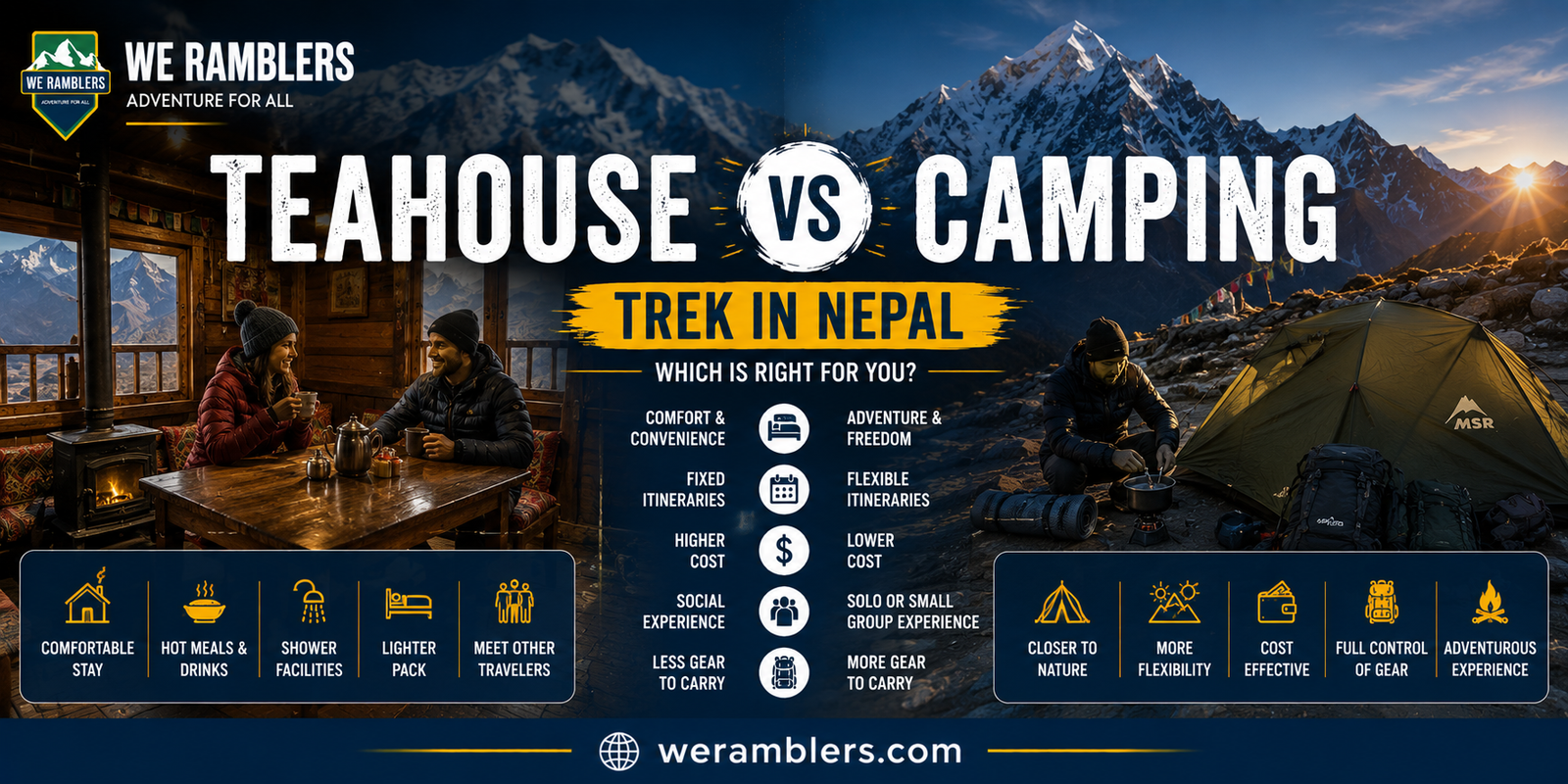
When planning a Nepal trek, one of the first decisions you face is whether to do a teahouse trek or a camping trek. For most first-time trekkers, the difference is not immediately obvious, and the decision has significant implications for cost, comfort, flexibility, and the overall experience.
This guide breaks down everything you need to know about teahouse trekking versus camping trekking in Nepal, so you can make the right choice before you book.
What Is a Teahouse Trek?
A teahouse trek is Nepal’s most popular style of trekking. Teahouses, also called lodge trekking or guesthouse trekking, are small family-run guesthouses located at regular intervals along established trekking routes. You walk from teahouse to teahouse each day, sleeping in a basic room and eating meals prepared in the teahouse kitchen.
On the busiest routes such as Everest Base Camp, Annapurna Circuit, Annapurna Base Camp, and Manaslu Circuit, teahouses are available at virtually every significant stop. You carry only your personal daypack. Larger bags are carried by porters.
What Do Teahouses Provide?
A standard teahouse room contains one or two beds with foam mattresses, pillows, and basic blankets. Rooms are almost always unheated. The only warm space is the communal dining room, which has a wood or yak-dung burning stove in the evening.
Meals are cooked fresh and served to order. The standard teahouse menu includes dal bhat (lentil soup and rice), noodle soups, fried rice, pasta, Tibetan bread, porridge, eggs, and a range of local snacks. Menus expand at lower altitudes and become more limited at higher elevations where supply chains are difficult.
Bathrooms are most often shared. Attached bathrooms exist at teahouses in Namche Bazaar, Lukla, and a few other well-served stops, but shared bathrooms are the norm on the trail.
WiFi is available at most major teahouses for a small fee.
What Is a Camping Trek?
A camping trek means you carry, or have porters carry, a full camp including tents, cooking equipment, food supplies, and all support gear. You sleep in tents, meals are prepared by a dedicated camp cook, and you are entirely self-sufficient from the trail.
Camping treks require a larger support team: a trekking guide, a cook, kitchen staff, and additional porters to carry the camp equipment and food. This makes camping treks more expensive and more logistically complex to organise.
When Is a Camping Trek Necessary?
On some trekking routes in Nepal, camping is not a choice. It is the only option. Routes that pass through areas without established teahouse infrastructure require full camping setups. These include:
The Kanchenjunga Circuit Trek, which is Nepal’s most remote major trek, has very limited teahouse infrastructure beyond certain sections.
The Dolpo Circuit Trek in Upper Dolpo is almost entirely a camping trek and one of the most demanding and isolated in Asia.
The Makalu Base Camp Trek has partial teahouse availability in lower sections but requires camping in upper sections.
Any off-trail or custom route outside established corridors requires camping.
On these routes, camping is built into the itinerary and there is no alternative.
Teahouse Trek vs Camping Trek: A Direct Comparison
Cost
Teahouse trekking is significantly cheaper than camping trekking. A self-arranged teahouse trek on the EBC route costs approximately USD 30 to 50 per day including accommodation, meals, and a guide. A fully organised teahouse trek with an agency costs USD 70 to 120 per day depending on group size and services.
A camping trek costs substantially more because of the additional staff and equipment required. Expect USD 120 to 200 per person per day for a well-organised camping trek on a remote route.
The cost difference is most dramatic on routes where teahouses are available. Choosing a camping trek on the Annapurna Circuit, where perfectly good teahouses exist, adds significant cost with limited benefit.
Comfort
Teahouses win on convenience but not necessarily on comfort. A good teahouse room is warm enough with your sleeping bag, and teahouse dal bhat is genuinely excellent and nutritious. The social environment of meeting trekkers from around the world in the communal dining room each evening is a major part of the teahouse trekking culture.
Camping gives you a private space and a dedicated cook who controls the menu entirely. If you have specific dietary requirements or simply prefer privacy, camping provides this on any route. High-quality camping setups with proper tents, sleeping mats, and experienced cooks make for a comfortable experience, but you are still sleeping in a tent at altitude.
Flexibility
Camping treks offer far greater route flexibility. You are not limited to routes with established teahouse infrastructure. You can camp in locations that teahouse trekkers never reach, including high alpine meadows, remote valley floors, and viewpoints above established trails.
Teahouse trekking locks you into established routes with accommodation at fixed points. If a teahouse is full or you want to sleep somewhere between two villages, that is generally not possible.
Environmental Impact
Both styles of trekking have environmental impacts. Camping treks in fragile remote zones carry high risk if not managed responsibly. Human waste, food waste, and firewood use are all issues that irresponsible operators neglect.
Well-run camping trek operators use designated campsites, practise Leave No Trace principles, and manage waste properly. Ask your operator explicitly about their environmental practices before booking.
Teahouse trekking concentrates impact at established nodes along the trail rather than distributing it across the wider landscape. This is generally considered a lower-impact option on environmentally sensitive routes.
Which Style Is Right for You?
Choose a teahouse trek if you are a first-time Nepal trekker, if you are trekking on the Everest Base Camp, Annapurna Circuit, Annapurna Base Camp, Manaslu Circuit, Langtang, or Gokyo Lakes routes, if you want to keep costs reasonable, if you enjoy the social atmosphere of meeting other trekkers, or if you prefer the simplicity of walking without managing camp logistics.
Choose a camping trek if you are trekking to Kanchenjunga, Upper Dolpo, Makalu Base Camp, or another route without teahouse infrastructure, if you want complete route flexibility and access to remote locations, if you have specific dietary requirements that teahouse menus cannot accommodate, if you strongly prefer privacy over the communal teahouse experience, or if budget is not a primary constraint.
For the vast majority of trekkers visiting Nepal for the first time, a teahouse trek on one of the established routes offers the best combination of comfort, cost, cultural experience, and logistical ease. Camping treks are best reserved for those seeking routes that specifically require them, or experienced trekkers wanting to push beyond the established trail network.
Both styles offer something genuinely special. The Himalayas are extraordinary from a teahouse window and extraordinary from a tent door. The mountain does not change based on how you sleep.
Book Your Nepal Teahouse or Camping Trek With We Ramblers
Whichever style suits you, We Ramblers has the experience and infrastructure to make it happen properly. We Ramblers operates both teahouse and camping treks across Nepal, with routes ranging from the classic Everest Base Camp and Annapurna Circuit to remote camping expeditions in Dolpo, Kanchenjunga, and Makalu.
For teahouse treks, the team selects vetted guesthouses at every stop, pairs you with an experienced licensed guide, and arranges porter support so your pack stays light throughout the journey. For camping treks, We Ramblers provides full camp equipment, a dedicated cook, kitchen staff, and all the logistical coordination that remote trekking requires.
Both India and Nepal-based trekkers find working with We Ramblers straightforward. The Bengaluru office handles pre-trip planning, flight coordination from Indian cities, and all communication before departure. The Kathmandu team takes over on arrival and manages everything on the ground. To explore available itineraries for both teahouse and camping treks across Nepal, visit weramblers.com or reach out to the team directly.