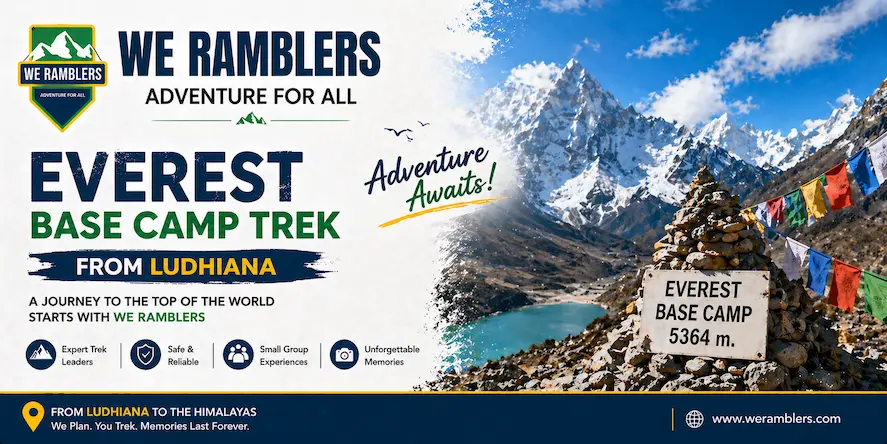
If you’re from Ludhiana and you’ve been dreaming of standing at 5,364 metres above sea level with the world’s highest mountain towering over you, you’re not as far from that dream as you think. The Everest Base Camp Trek from Ludhiana is one of the most rewarding Himalayan adventures available to trekkers from Punjab, and with the right planning, it is absolutely achievable for anyone with a reasonable level of fitness and a passion for the outdoors.
At We Ramblers, we have helped hundreds of Indian trekkers make this exact journey. Reach us at our India office: +91 9886274292 | Mail: trip@weramblers.com
How to Reach Kathmandu for the EBC Trek from Ludhiana
The journey to Everest Base Camp begins long before you set foot on the Khumbu trail. Your first task is getting from Ludhiana to Kathmandu, which is your gateway to Nepal.
Option 1: Fly via Delhi or Amritsar (Recommended)
Ludhiana’s Sahnewal Airport (LUH) has limited direct international connectivity, so the fastest and most practical route is to take a short domestic flight or train to Delhi (Indira Gandhi International Airport) and then board a direct international flight to Tribhuvan International Airport (KTM) in Kathmandu. Airlines like IndiGo, Air India, and SpiceJet operate regular Delhi-Kathmandu flights. The total journey from Ludhiana to Kathmandu, including the connection in Delhi, takes roughly 7 to 9 hours.
Alternatively, if you prefer flying from a closer hub, Amritsar’s Sri Guru Ram Dass Jee International Airport is roughly 90 minutes from Ludhiana by road and offers connecting options to Kathmandu as well.
Estimated flight cost (Ludhiana/Delhi to Kathmandu, round trip): INR 8,000 to INR 18,000 depending on how far in advance you book.
Option 2: Train and Bus Combination (Budget Route)
For those on a tighter budget, you can take a train from Ludhiana to Gorakhpur or Varanasi, and then connect by road across the Sonauli border into Nepal, followed by a bus to Kathmandu. This route takes 24 to 36 hours but costs significantly less. Keep in mind this adds travel fatigue before the trek even begins.
Pro Tip for Ludhiana Trekkers: Indian citizens do not need a visa to enter Nepal. A valid government-issued ID such as a passport, Aadhaar card, or voter ID is sufficient at most entry points, though carrying a passport is strongly recommended for the Lukla flight.
Everest Base Camp Trek Itinerary from Ludhiana (14-Day Plan)
Here is a practical, day-by-day EBC trek itinerary from Ludhiana.
Day 1: Travel from Ludhiana to Kathmandu (fly via Delhi or Amritsar). Check into your hotel in Thamel, collect permits, and prepare your gear.
Day 2: Morning flight from Kathmandu to Lukla (2,860m). Trek to Phakding (2,610m). Walking time: approximately 3 hours.
Day 3: Trek from Phakding to Namche Bazaar (3,440m). This is a demanding day with a significant altitude gain. Walking time: 5 to 6 hours.
Day 4: Acclimatization day in Namche Bazaar. Hike up to the Everest View Hotel (3,880m) for your first clear views of Everest, Ama Dablam, Thamserku, and Lhotse. Visit the Sherpa Cultural Museum.
Day 5: Trek from Namche Bazaar to Tengboche (3,860m). Visit the iconic Tengboche Monastery, the oldest and largest in the Khumbu region. Walking time: 5 hours.
Day 6: Trek from Tengboche to Dingboche (4,410m). The landscape opens up dramatically here with wide glacial valleys. Walking time: 5 hours.
Day 7: Acclimatization day in Dingboche. Hike to Nangkartshang Peak (5,083m) for panoramic views of Makalu, Cho Oyu, and Lhotse.
Day 8: Trek from Dingboche to Lobuche (4,940m). This is one of the most challenging days as altitude bites harder. Walking time: 5 to 6 hours.
Day 9: Trek from Lobuche to Gorak Shep (5,170m) and then to Everest Base Camp (5,364m). Walking time: 7 to 8 hours total. This is the day you’ve trained for.
Day 10: Early morning hike to Kala Patthar (5,545m) for sunrise views of Everest. Descend to Pheriche (4,240m). Walking time: 7 hours.
Day 11: Trek from Pheriche to Namche Bazaar (3,440m). Walking time: 6 to 7 hours.
Day 12: Trek from Namche Bazaar back to Lukla (2,860m). Walking time: 6 hours.
Day 13: Fly from Lukla back to Kathmandu. Rest, celebrate, and explore Thamel.
Day 14: Return flight from Kathmandu to Ludhiana via Delhi or Amritsar.
Note on Ramechhap Airport: During peak trekking months of April, May, October, and November, the Nepal government often diverts Lukla flights from Kathmandu to Ramechhap Airport (a 4-hour drive from Kathmandu). Factor this in when planning your departure days.
Everest Base Camp Trek Cost from Ludhiana (2026 Breakdown in INR)
One of the first questions every Ludhiana trekker asks is how much the whole trip will cost. Here is a realistic, itemised breakdown for 2026.
| Expense Item | Estimated Cost (INR) |
|---|---|
| Ludhiana to Kathmandu flights (round trip) | INR 10,000 – 18,000 |
| Kathmandu to Lukla flights (round trip) | INR 30,000 – 40,000 |
| Trek package (guide, porter, teahouse accommodation, meals) | INR 55,000 – 1,20,000 |
| Sagarmatha National Park Permit (SAARC rate) | INR 1,500 (approx NPR 1,500) |
| Khumbu Pasang Lhamu Rural Municipality Permit | INR 2,000 (approx NPR 2,000) |
| Travel insurance (high-altitude cover) | INR 5,000 – 12,000 |
| Gear and clothing (if purchasing) | INR 10,000 – 30,000 |
| Kathmandu hotel (2 nights) | INR 3,000 – 8,000 |
| Miscellaneous (tips, extra food, SIM card) | INR 8,000 – 15,000 |
| Total Estimated Budget | INR 1,24,500 – 2,43,000 |
For Indian and SAARC passport holders: The Sagarmatha National Park Entry Permit costs NPR 1,500 per person, which is half the price that non-SAARC foreign nationals pay. This is a meaningful saving.
Group trek advantage: Joining a group departure organized by We Ramblers can save you INR 10,000 to INR 20,000 compared to booking a private trek, since guide and porter costs are shared among participants. Reach us at our India office: +91 9886274292 | Mail: trip@weramblers.com
Permits Required for the Everest Base Camp Trek from Ludhiana
Getting your permits sorted before or upon arrival in Kathmandu will save you time and stress on the trail. As of 2026, trekkers heading to Everest Base Camp need the following:
1. Sagarmatha National Park Entry Permit This is your entry ticket into one of the world’s most protected high-altitude ecosystems, which is also a UNESCO World Heritage Site. For SAARC nationals including Indians, the cost is NPR 1,500 per person. You can obtain this at the Nepal Tourism Board office in Kathmandu or at the park entry gate in Monjo.
2. Khumbu Pasang Lhamu Rural Municipality Permit Introduced in 2018, this local government permit replaced the old TIMS card system for the Everest region. It costs NPR 2,000 to NPR 3,000 per person depending on current local rates and is obtained in Lukla or Monjo upon arrival. This permit directly funds community infrastructure, trail maintenance, and Sherpa village development.
Note for Indian Trekkers: You no longer need a TIMS (Trekkers’ Information Management System) card for the Everest Base Camp route. The Khumbu municipality permit fully replaces it in this region.
Carry at least two passport-sized photographs and a copy of your passport or government ID when collecting permits.
Best Time to Do the Everest Base Camp Trek from Ludhiana
Choosing the right season is critical for a successful EBC trek from Ludhiana. There are two primary windows.
Spring: March to May
Spring is the most popular season for the EBC trek. The weather is relatively stable, temperatures are warmer than in autumn, and the trail is alive with blooming rhododendrons. April and May are especially popular because summit climbing season on Everest runs simultaneously, meaning you may share trail space with serious mountaineering expeditions heading up. Views are generally clear.
- Average daytime temperature at base camp: -5°C to 5°C
- Night temperature at Gorak Shep: -10°C to -20°C
Autumn: September to November
Autumn is equally popular and considered by many experienced trekkers to offer the best views. Post-monsoon skies are clear, mountain visibility is outstanding, and the landscape is lush from recent rains. October is the single best month for a clear, photogenic trek.
- Average daytime temperature at base camp: -8°C to 2°C
- Night temperature at Gorak Shep: -15°C to -25°C
Seasons to Avoid
- Monsoon (June to August): Heavy rainfall, leeches on lower trails, cloud-covered peaks, and significant risk of landslides and trail disruption.
- Winter (December to February): Brutally cold, especially above 4,000 metres. The trail is passable but requires experience with extreme cold and the risk of frostbite is real. Not recommended for first-time trekkers.
EBC Trek from Ludhiana Difficulty Level and Physical Preparation
The EBC trek is graded moderate to strenuous. The difficulty comes primarily from altitude rather than any technical terrain. You will walk 5 to 8 hours daily for 10 to 12 consecutive days, often on uneven rocky trails. At elevations above 4,000 metres, even a gentle uphill walk can feel exhausting.
Recommended Fitness Training for Ludhiana Trekkers
Begin training at least 8 to 12 weeks before your departure date. Since Ludhiana sits at roughly 247 metres above sea level, you won’t be able to simulate altitude at home, so cardiovascular conditioning is your best preparation tool.
Weeks 1 to 4 – Build Base Fitness:
- Daily 45-minute brisk walks or jogging sessions
- Stair climbing for 20 to 30 minutes (great simulation for Nepali trail steps)
- Cycling or swimming 3 times per week
Weeks 5 to 8 – Add Load and Endurance:
- Hike with a 6 to 8 kg loaded backpack on weekends
- Increase stair sessions to 40 minutes
- Join a local gym for leg strength and core training
Weeks 9 to 12 – Simulate Trek Conditions:
- Back-to-back long walks (2 to 4 hours each day over a weekend)
- Carry your full trek pack during these sessions
- If possible, visit higher altitude destinations like Manali, Dharamsala, or Shimla in Himachal Pradesh to give your body a preview of what altitude adjustment feels like
Ludhiana trekkers note: The Shivalik Hills are within driving distance and offer excellent trail options for weekend training hikes before your Nepal departure.
Altitude Sickness: What Every Trekker from Punjab Needs to Know
Altitude sickness (Acute Mountain Sickness, or AMS) is the single most common reason trekkers turn back before reaching Everest Base Camp. It does not discriminate by fitness level. Understanding it is essential.
Symptoms of AMS to Watch For:
- Persistent headache that does not respond to paracetamol
- Nausea and vomiting
- Loss of appetite
- Dizziness and difficulty maintaining balance
- Extreme fatigue disproportionate to your exertion level
- Shortness of breath at rest
Golden Rules of Acclimatization:
- Never ascend more than 300 to 400 metres in altitude per day above 3,000 metres
- Follow the trekking principle: climb high, sleep low
- Take mandatory acclimatization days in Namche Bazaar and Dingboche
- Stay hydrated. Drink a minimum of 3 to 4 litres of water or warm fluids daily
- Avoid alcohol above 3,500 metres
- If symptoms worsen, descend immediately. No summit view is worth your health
On Diamox (Acetazolamide): Many trekkers carry this medication as a preventive measure. Consult your doctor before the trek. Diamox helps your body acclimatize faster but does not prevent severe AMS if you ignore warning signs.
What to Pack for the Everest Base Camp Trek from Ludhiana
Packing right can make your trek significantly more comfortable. Below is a focused checklist.
Clothing:
- Down jacket (rated to at least -15°C for summit nights)
- Thermal base layers (top and bottom), minimum 2 sets
- Fleece mid-layer
- Trek pants, at least 2 pairs
- Waterproof outer jacket and pants
- Warm hat, balaclava, and neck gaiter
- Trekking gloves plus an additional pair of thick winter gloves
- Wool or moisture-wicking socks, 5 to 6 pairs
- Sturdy waterproof trekking boots (broken in before the trek)
- Trekking sandals or camp shoes
Gear and Equipment:
- 50 to 60 litre backpack for main luggage (carried by porter)
- 20 to 25 litre day pack (carried by you)
- Trekking poles (highly recommended above 4,000 metres)
- Headlamp with extra batteries
- Sleeping bag rated to -15°C (teahouses have blankets but not always adequate)
- Sunglasses with UV400 or Category 3 protection (snow reflection is intense)
- Pulse oximeter (monitors blood oxygen saturation levels)
- Water bottles and purification tablets or a filter
- Sunscreen SPF 50+
Documents (keep physical copies):
- Passport and copies
- Travel insurance documents with emergency helicopter evacuation cover
- Passport-sized photographs (minimum 4)
- Permit receipts once obtained
Important: Most gear can be rented or purchased affordably in Kathmandu’s Thamel district, so do not stress if you are missing a few items from Ludhiana.
Key Highlights Along the EBC Trail
Namche Bazaar (3,440m)
The buzzing commercial hub of the Khumbu region, Namche Bazaar offers bakeries, gear shops, internet cafes, and the first genuine view of Everest on the classic route. Your acclimatization day here is the most important rest day of the trek.
Tengboche Monastery (3,860m)
The spiritual heart of the Everest region. This 400-year-old monastery sits on a ridge with a jaw-dropping backdrop of Ama Dablam, Everest, and Nuptse. Try to arrive for the morning prayer ceremony if your schedule allows.
Khumbu Glacier and Icefall
As you approach base camp via the Khumbu moraine, you’ll walk alongside the Khumbu Glacier, a living, shifting river of ancient ice. The Khumbu Icefall above camp is where mountaineers begin their actual summit attempts.
Kala Patthar (5,545m)
This black-rock peak above Gorak Shep is where most trekkers take their most iconic photographs. The sunrise view of Everest from here, with alpenglow turning the summit gold, is one of the most celebrated sights in all of mountain trekking.
Everest Base Camp (5,364m)
The final destination. Surrounded by the roar of the wind, prayer flags whipping against the sky, and the Khumbu Glacier crunching below, standing here is deeply emotional for nearly every trekker who makes it.
Do Indian Trekkers Need a Visa for Nepal?
No. Indian passport holders do not require a visa to enter Nepal. A valid Indian passport is sufficient. However, carrying your passport is strongly recommended because it is required for the Lukla flight check-in and permit collection.
Travel Insurance for the Everest Base Camp Trek from Ludhiana
Travel insurance with high-altitude and emergency helicopter evacuation cover is not optional for the EBC trek from Ludhiana. A helicopter rescue from above 4,000 metres can cost anywhere from USD 3,000 to USD 8,000 without insurance coverage. This is a non-negotiable expense.
When purchasing insurance from India, confirm that:
- The policy covers trekking to a minimum of 5,500 metres
- Emergency helicopter evacuation is included
- Medical treatment in Nepal is covered
- Trip cancellation due to flight delays is included (Lukla flights are frequently delayed due to weather)
Why Trek with We Ramblers for Your EBC Adventure from Ludhiana
We Ramblers is a registered adventure travel and trekking company with offices in both Nepal and India. Our India office (+91 9886274292) is specifically set up to serve Indian trekkers from cities like Ludhiana, Chandigarh, Amritsar, and Delhi who want to explore the Himalayas without the stress of planning every detail independently.
When you book your Everest Base Camp Trek with We Ramblers, your package includes:
- Expert, licensed local guide with first-aid and altitude sickness training
- Porter service (maximum 20 kg of your luggage carried for you)
- All teahouse accommodation on the trail
- Three meals per day throughout the trek
- All permits and their coordination
- Kathmandu–Lukla–Kathmandu flights arranged
- Emergency evacuation coordination
We also offer other popular Nepal treks including the Gokyo Lakes Trek, the Three Passes Trek, and the Annapurna Base Camp Trek for those interested in extending their Nepal adventure or planning future trips.
Frequently Asked Questions: Everest Base Camp Trek from Ludhiana
Q: How long does the Everest Base Camp Trek take from Ludhiana?
A: Including travel days from Ludhiana to Kathmandu and back, the entire trip takes 16 to 18 days. The trek itself is 12 to 14 days.
Q: Is the Everest Base Camp Trek possible for beginners from Ludhiana?
A: Yes, but it requires serious physical preparation. You don’t need mountaineering experience, but you must build cardiovascular endurance through at least 10 to 12 weeks of training before departure.
Q: What is the total cost of the EBC Trek for an Indian trekker?
A: A realistic total budget including all flights, trek package, permits, insurance, and personal expenses falls between INR 1,25,000 and INR 2,50,000 per person, depending on the level of service you choose.
Q: Do I need a guide for the Everest Base Camp Trek from Ludhiana?
A: The EBC trail is well-marked and teahouses are located every few hours. Trekking with a licensed guide is highly recommended for safety, acclimatization management, and permit coordination.
Q: What is the minimum number of days needed for the EBC Trek from Ludhiana?
A: Rushing the EBC Trek below 12 days significantly increases altitude sickness risk. A 12-day minimum from Lukla is widely recommended by medical authorities and trekking professionals.
Q: When should a trekker from Ludhiana book their EBC Trek?
A: For the spring window (April to May), book at least 3 to 4 months in advance. For autumn (October to November), 2 to 3 months advance booking is advisable. Lukla flights in peak season sell out quickly.
Q: What happens if my Lukla flight gets cancelled?
A: Lukla weather delays are common. Always build 2 buffer days into your itinerary at the end. We Ramblers coordinates flight rescheduling for all clients and monitors weather conditions closely.
Q: Can senior trekkers attempt the EBC Trek from Ludhiana?
A: Trekkers in their 50s and 60s successfully complete EBC every season. Medical fitness is more important than age. A medical check-up and consultation with your doctor before the trek is strongly recommended for anyone over 50.
Ready to Book Your Everest Base Camp Trek from Ludhiana?
The Everest Base Camp Trek from Ludhiana is not a trip you stumble into. It rewards those who prepare seriously, plan carefully, and choose the right team to support them on the mountain. At We Ramblers, our team of experienced trekking professionals is ready to help you plan every step from Ludhiana to the foot of the world’s highest peak.
Contact We Ramblers today:
- India Office: +91 9886274292
- Nepal Office: +977 9848061684
- Visit our Everest Base Camp Trek page
- Browse all our Nepal trekking packages
Tell us your preferred travel dates, group size, and fitness level, and we will put together a customised EBC itinerary from Ludhiana that works for you. Fixed group departures are also available for solo trekkers from Ludhiana who want to join a team.
Your Everest journey starts in Ludhiana. Let We Ramblers take you the rest of the way.
For further reading on trekking requirements and Nepal travel regulations, the Nepal Tourism Board is the official authority for all permits and trekking guidelines.