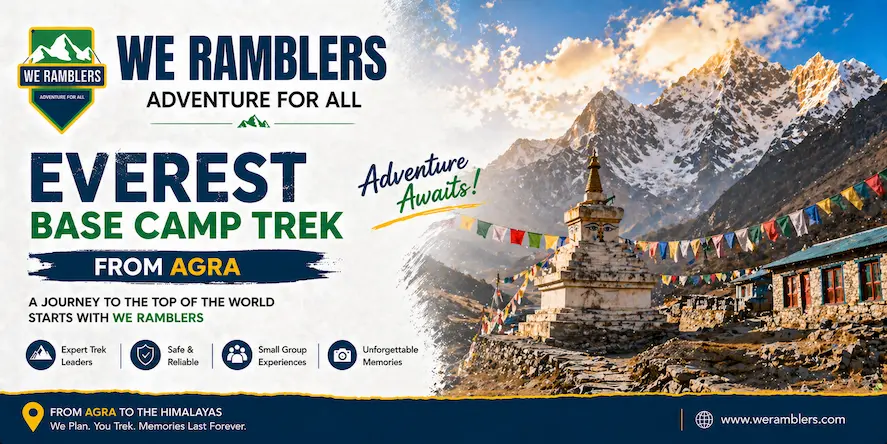
Standing at 5,364 metres above sea level, at the foot of the world’s highest mountain, is not a fantasy for people from Agra. The Everest Base Camp Trek from Agra is one of the most rewarding high-altitude adventures an Indian trekker can take on, and it is more accessible, more affordable, and more achievable than most people realise. Whether you have watched the Himalayas from afar or dreamed about following in the footsteps of Tenzing Norgay and Edmund Hillary, We Ramblers makes it happen, handling every detail from your first step out of Agra to the moment you stand on the Khumbu Glacier.
We Ramblers has been running guided treks to Everest Base Camp for Indian travellers for years, with offices in both India and Nepal. Reach us at our India office: +91 9886274292 | Mail: trip@weramblers.com
How to Reach Kathmandu for the EBC Trek from Agra
The EBC trek begins in Kathmandu, and getting there from Agra involves one of three routes.
By Flight via Delhi (Recommended)
There are no direct flights from Agra Airport (AGR) to Kathmandu’s Tribhuvan International Airport (KTM). The fastest and most practical option is to take a connecting flight via Delhi. IndiGo, Air India, and Nepal Airlines operate regular connecting services. Travel time from Agra to Kathmandu via Delhi is typically under 4 hours. One-way fares from Agra to Kathmandu via Delhi start around ₹8,000–₹22,000 depending on the season and how far in advance you book.
By Train to Gorakhpur, Then Bus
If you want to experience the overland route, take a train from Agra Fort or Agra Cantt to Gorakhpur (around 8–10 hours). From Gorakhpur, shared jeeps and buses run to the Sunauli–Belahiya border crossing into Nepal. From there, tourist buses continue to Kathmandu (around 8–10 hours). The full overland journey takes 20–24 hours but costs significantly less, starting at ₹1,500–₹3,500 all in.
By Flight via Varanasi
Varanasi has direct flights to Kathmandu operated by IndiGo and Buddha Air. You can take an express train from Agra to Varanasi and then fly. This option is slightly slower than going via Delhi but offers a scenic alternative.
Indian nationals do not require a visa for Nepal. You can travel with a valid passport, Voter ID, or government-issued photo ID. A passport is strongly recommended for the EBC trek due to documentation requirements at permit checkpoints.
Everest Base Camp Trek from Agra Overview
| Detail | Info |
|---|---|
| Trek Duration | 12–14 days (from Lukla) |
| Max Altitude | 5,545 m (Kala Patthar) |
| EBC Altitude | 5,364 m |
| Trek Distance | ~130 km round trip |
| Difficulty | Challenging (no technical climbing) |
| Best Season | March–May and September–November |
| Starting Point | Lukla (fly from Kathmandu) |
| Trek Style | Teahouse trek |
The EBC trek from Agra is graded as challenging due to altitude rather than technical terrain. You do not need mountaineering skills or ropes. What you need is cardiovascular fitness, mental determination, and proper acclimatisation. People between the ages of 18 and 70 complete this trek regularly.
Best Time to Do the Everest Base Camp Trek from Agra
Spring Season: March to May
Spring is the most popular trekking window for Indian trekkers. Temperatures are warmer, rhododendron forests bloom in vivid colour, and skies are generally clear. April is the peak month when mountaineering expeditions are also on the trail, adding an extra dimension of energy to the route.
Ideal for: First-timers, photography, maximum trail infrastructure.
Autumn Season: September to November
October and November offer crisp, post-monsoon air with exceptional visibility. The trails are dry, views of Everest and surrounding peaks like Lhotse, Nuptse, Ama Dablam, and Makalu are at their clearest, and teahouses are fully stocked.
Ideal for: Clear summit views, slightly cooler temperatures, experienced trekkers.
Monsoon Season: June to August
This is a shoulder season with heavy rainfall, leeches on lower trails, and frequent Lukla flight cancellations. It is not recommended for first-time EBC trekkers from India, though some prefer it to escape peak-season heat in the plains.
Winter Season: December to February
Cold temperatures at altitude can drop below -20°C at higher camps. Trails are less crowded and permit costs are lower, but the risk of snowfall, frostbite, and route closures increases substantially.
Everest Base Camp Trek from Agra Itinerary
This is the standard 14-day itinerary We Ramblers follows for trekkers joining the EBC trek from Agra.
Day 1: Arrive in Kathmandu (1,400 m)
You arrive in Kathmandu, where our team receives you at Tribhuvan International Airport. Evening trek briefing, gear check, and permit processing. Stay in Thamel.
Day 2: Fly Kathmandu to Lukla – Trek to Phakding (2,610 m)
A 30–40 minute mountain flight to Lukla’s Tenzing-Hillary Airport, one of the most thrilling short-haul flights in the world. Trek begins immediately to Phakding along the Dudh Koshi River. Walk time: 3–4 hours.
Day 3: Phakding to Namche Bazaar (3,440 m)
Cross multiple suspension bridges over the Dudh Koshi River and enter Sagarmatha National Park at Monjo checkpoint. A steep final climb leads to Namche Bazaar, the Sherpa capital of the Khumbu Valley. Walk time: 5–6 hours.
Day 4: Acclimatisation Day in Namche Bazaar
Mandatory rest day for altitude adaptation. Morning hike to Everest View Hotel (3,880 m) for your first close-up view of Everest, Lhotse, and Ama Dablam. Explore Namche’s Sherpa Cultural Museum, markets, and bakeries. Walk time: 3 hours (leisure hike).
Day 5: Namche Bazaar to Tengboche (3,860 m)
A spectacular ridge walk through pine and rhododendron forests with panoramic Himalayan views. Tengboche Monastery, the largest in the Khumbu region, sits on a hill with Ama Dablam rising dramatically behind it. Walk time: 5–6 hours.
Day 6: Tengboche to Dingboche (4,410 m)
Descend to Pangboche, cross the Imja Khola River, and ascend through alpine meadows to Dingboche. Views of Ama Dablam dominate the trail. Walk time: 5 hours.
Day 7: Acclimatisation Day in Dingboche
Second key acclimatisation day. Optional hike to Nangkartshang Peak (5,083 m) for 360-degree views of Makalu, Lhotse, Ama Dablam, and Tawache. This climb-high-sleep-low strategy is critical for preventing Acute Mountain Sickness (AMS). Walk time: 4 hours.
Day 8: Dingboche to Lobuche (4,940 m)
The trail passes Thukla Pass and a series of stone memorials to climbers who lost their lives on Everest. The Khumbu Glacier moraine flanks the trail. Walk time: 5 hours.
Day 9: Lobuche to Gorakshep – Everest Base Camp (5,364 m)
The most anticipated day. Reach Gorakshep (5,164 m) for lunch, then push on to Everest Base Camp. Stand amid the prayer flags and colourful expedition tents on the Khumbu Glacier. Return to Gorakshep for the night. Walk time: 7–8 hours.
Day 10: Gorakshep – Kala Patthar (5,545 m) – Pheriche (4,371 m)
Pre-dawn start for Kala Patthar, the highest point of the entire trek and the best viewpoint for Everest above Base Camp. Watch alpenglow turn the summit golden at sunrise. Descend all the way to Pheriche. Walk time: 7–8 hours.
Day 11: Pheriche to Namche Bazaar (3,440 m)
Long descending day through Tengboche and back towards the lower Khumbu. The body feels noticeably stronger at lower altitude. Walk time: 7 hours.
Day 12: Namche Bazaar to Lukla (2,840 m)
Final descent back to Lukla. Celebration dinner with your guide and porter team. Walk time: 6 hours.
Day 13: Fly Lukla to Kathmandu
Morning flight back to Kathmandu. Rest of the day free to explore Thamel, Boudhanath Stupa, or Pashupatinath Temple.
Day 14: Departure from Kathmandu
Transfer to Tribhuvan International Airport for your return flight to Agra via Delhi.
Everest Base Camp Trek Cost from Agra (2026 Breakdown)
Here is a realistic cost structure for trekkers departing from Agra in 2026.
Travel to Kathmandu from Agra
- Flight via Delhi: ₹8,000–₹22,000 one-way
- Train + Bus (Gorakhpur route): ₹1,500–₹3,500
Nepal Visa
Indian nationals do not require a visa for Nepal. Zero cost.
Trekking Permits (SAARC Rates for Indians)
- Sagarmatha National Park Entry Permit: NPR 1,500 (~₹940)
- Khumbu Pasang Lhamu Rural Municipality Permit: NPR 2,000 (~₹1,250)
Kathmandu to Lukla Domestic Flight (Round Trip)
- ₹28,000–₹35,000 (included in most guided packages)
Guided Trek Package
| Package Type | Approximate Cost (Per Person) |
|---|---|
| Budget (group, basic teahouses) | ₹70,000–₹95,000 |
| Standard (guided, all meals included) | ₹1,00,000–₹1,40,000 |
| Premium (small group, better lodges) | ₹1,40,000–₹1,85,000 |
| Luxury (private guide, helicopter return) | ₹2,50,000+ |
What a standard We Ramblers EBC package includes: Licensed guide, porter (up to 10 kg), all teahouse accommodation, three meals daily on the trail, all required trekking permits, Lukla return flights, Kathmandu transfers, and emergency support.
Total estimated cost from Agra (all-in):
Most trekkers from Agra spend between ₹1,10,000 and ₹1,65,000 for a safe, guided 14-day EBC experience. Budget trekkers managing costs carefully can complete it around ₹85,000–₹1,00,000. Luxury options exceed ₹2,50,000.
Book your EBC Trek package with We Ramblers
EBC Trek Permits for Indian Trekkers
Two permits are mandatory for the Everest Base Camp trek, and both are checked at multiple points along the trail.
Sagarmatha National Park Entry Permit This protects the UNESCO World Heritage Site around Everest. Indian SAARC nationals pay NPR 1,500 (~₹940), compared to NPR 3,000 for non-SAARC nationals.
Khumbu Pasang Lhamu Rural Municipality Permit Introduced in 2018, this replaced the TIMS Card for EBC trekkers. Cost is NPR 2,000 (~₹1,250) for all nationalities.
Important note for Indians: The TIMS Card is no longer required on the Khumbu/EBC route as of 2023. No additional government permits are needed unless you are extending to routes like Jiri or Gokyo. When you trek with We Ramblers, all permit processing is handled on your behalf.
Altitude and Acclimatisation: What Indian Trekkers Need to Know
Altitude sickness is the number one reason trekkers turn back before reaching EBC. Understanding it in advance is your most effective prevention strategy.
What Happens at High Altitude
At 3,500 m (roughly Namche Bazaar), your body has around 65% of the oxygen available at sea level. At 5,000 m, this drops further. Symptoms of Acute Mountain Sickness (AMS) include persistent headache, nausea, dizziness, fatigue, and loss of appetite.
More serious conditions like High Altitude Pulmonary Oedema (HAPE) and High Altitude Cerebral Oedema (HACE) are rare but potentially life-threatening if symptoms are ignored.
The Golden Rules of Acclimatisation on the EBC Trek from Agra
- Never ascend more than 500 m per day above 3,000 m. The itinerary above is designed around this.
- Follow the “climb high, sleep low” principle. Acclimatisation day hikes to higher altitude, with a return to sleep at a lower point.
- Stay hydrated. Drink 3–4 litres of water daily at altitude. Dehydration worsens AMS symptoms significantly.
- Never ignore symptoms. If headache persists or worsens after rest and hydration, descend. No view is worth HAPE or HACE.
- Consult a doctor about Diamox (Acetazolamide). Many Indian trekkers use it as a prophylactic. Discuss dosage with your physician before departure.
We Ramblers guides carry supplemental oxygen and comprehensive high-altitude medical kits on all EBC treks.
Fitness Training for the Everest Base Camp Trek from Agra
You do not need to be an elite athlete. You do need to be fit enough to walk 5–8 hours a day for 12 consecutive days, often on uneven, rocky terrain, at oxygen levels your body has never experienced.
Recommended Training (Start 3–4 Months Before)
- Cardiovascular base: Walk, run, cycle, or swim for 45–60 minutes at least 4 times per week. Build up to 90-minute sessions.
- Long hikes: Weekend hikes of 15–25 km carrying a loaded daypack of 6–8 kg simulate trail conditions accurately.
- Stair climbing: Agra’s flat terrain limits hill training, but stair climbs replicate the sustained uphill effort on the EBC trail. Target 30–45 minute stair sessions.
- Strength training: Focus on legs (squats, lunges), core (planks, bridges), and posterior chain. Strong legs reduce knee strain on steep descents.
- Altitude simulation: If possible, plan a preparatory trek at 3,000–4,000 m before EBC. Options include Triund, Kedarkantha, or Kuari Pass for Indian trekkers.
What to Pack for the EBC Trek from Agra
Packing right is not about carrying more. It is about carrying the right things.
Clothing Layers (the Layering System)
- Moisture-wicking base layer (thermal)
- Mid-layer fleece or down jacket
- Waterproof, windproof outer shell
- Insulated down jacket (850-fill or equivalent) for high camps
- Warm hat, gloves, balaclava
- Trekking pants and thermal leggings
- Waterproof trekking boots (broken in before the trek)
- Gaiters for snow sections above Dingboche
Gear Essentials
- 40–50 litre trekking backpack
- Trekking poles (crucial for knee protection on descents)
- Headlamp with spare batteries
- Sunglasses (Category 3 or 4 UV protection – critical at altitude)
- Sun cream SPF 50+ and lip balm
- Personal first-aid kit including blister plasters
- Water purification tablets or a UV-SteriPen (saves ₹4,000–₹8,000 on bottled water)
- Sleeping bag rated to -15°C (many teahouses have blankets, but your own bag is safer above 4,000 m)
- Power bank (charging at teahouses costs ₹100–₹300 per device)
Documents
- Passport (strongly recommended over Voter ID for EBC)
- Two passport-size photographs (for permits)
- Travel insurance documents (must cover high-altitude trekking and emergency helicopter evacuation)
Teahouse Accommodation on the EBC Trek from Agra
Every night of the EBC trek is spent in a teahouse or trekking lodge. These are family-run guesthouses that serve meals and provide basic accommodation in private or shared rooms.
What to expect:
- Simple but clean rooms with twin beds and heavy blankets
- Shared bathrooms in most teahouses below Namche; some attach bathrooms available at higher cost
- Wood and yak-dung stoves in dining halls – the warmest room after 6 PM
- Wi-Fi available (at extra cost) up to Namche reliably; beyond that it becomes patchy
- Charging facilities available for a fee at all teahouses (₹100–₹300 per charge)
- Mobile network (Ncell or Nepal Telecom SIM) covers the trail up to around Namche on roaming
At altitude above 4,000 m, teahouses are more basic and colder. A quality sleeping bag makes a significant difference from Dingboche upward.
Recommended teahouse stops on the route:
- Namche Bazaar: Sherpa-run lodges with attached bathrooms, hot showers, excellent food
- Tengboche: Limited options but a stunning location opposite the monastery
- Dingboche: Well-developed, warm lodges with strong menu options
- Gorakshep: Most basic lodges on the trek – cold, crowded in peak season, but unforgettable
Top Highlights of the Everest Base Camp Trek from Agra
Namche Bazaar – The Gateway Sherpa Town
Namche is a thriving mountain town set in a horseshoe valley at 3,440 m. It has bakeries, gear shops, a museum dedicated to Sherpa history and Hillary and Norgay’s legendary 1953 ascent, and the first clear views of Everest from the Sagarmatha National Park viewpoint above town.
Tengboche Monastery – Heart of the Khumbu
Set against a backdrop of Ama Dablam, Tengboche Monastery is the spiritual centre of the Sherpa community and the largest monastery in the Khumbu region. Morning prayers here, with Everest visible behind the incense smoke, are among the most atmospheric moments on the entire trail.
Khumbu Glacier – Ice in Motion
Above Lobuche, the trail traverses the lateral moraine of the Khumbu Glacier. This is the longest glacier in Nepal and one of the highest in the world. The scale of it is humbling.
Everest Base Camp (5,364 m)
Reaching Base Camp means standing where every Everest summit attempt begins. You will see expedition tents, fixed ropes staged for the Icefall, colourful prayer flags, and surrounding peaks like Khumbutse, Pumori, Nuptse, and Lingtren. Note: Everest’s summit itself is not visible from Base Camp due to the angle of the surrounding ridges.
Kala Patthar (5,545 m) – The Best View on the Trek
Kala Patthar gives the most unobstructed view of Everest on the entire trek. The pre-dawn climb by headlamp and the moment the sun catches the summit at first light is the single most-photographed experience in Himalayan trekking. Worth every early-morning step.
Safety on the EBC Trail
Travel Insurance – Non-Negotiable
Every trekker on the EBC route must carry travel insurance that specifically covers high-altitude trekking above 5,000 m and emergency helicopter evacuation. A helicopter rescue from Kala Patthar altitude costs $3,000–$5,000 USD without insurance. With it, costs are covered in full. Reliable providers for Indian trekkers include Bajaj Allianz, HDFC ERGO, and international options like World Nomads.
The 2023 Mandatory Guide Regulation
Since April 2023, solo independent trekking on the EBC route has been prohibited by Nepal’s government. All trekkers must be accompanied by a licensed guide from a registered trekking agency. This regulation protects trekker safety and supports local employment.
Emergency Evacuation Protocol
We Ramblers maintains emergency contact protocols and coordinates with helicopter services throughout the trek. All guides carry satellite communication capability on EBC departures.
Everest Base Camp Trek Route Map from Agra – Key Waypoints
The classic EBC route follows the Khumbu Valley north from Lukla:
Lukla (2,840 m) → Phakding (2,610 m) → Namche Bazaar (3,440 m) → Tengboche (3,860 m) → Dingboche (4,410 m) → Lobuche (4,940 m) → Gorakshep (5,164 m) → Everest Base Camp (5,364 m) → Kala Patthar (5,545 m)
Total one-way distance: approximately 65 km. Total elevation gain from Lukla to Kala Patthar: approximately 2,705 m.
Related Treks to Consider with We Ramblers
If you are already making the journey from Agra to Nepal, these are the treks most commonly combined or compared with EBC:
- Gokyo Lakes and Gokyo Ri Trek – An alternate approach to the Everest region via the stunning turquoise Gokyo lakes. Fewer crowds, comparable altitude.
- Three Passes Trek – The premium Everest region experience, crossing Kongma La, Cho La, and Renjo La passes. For experienced trekkers wanting more than the standard route.
- Annapurna Base Camp Trek – Lower altitude, lush terrain, and a different face of Nepal’s mountains. A strong alternative for those building towards EBC.
- Mardi Himal Trek – A shorter 6–8 day trek with fewer crowds and beautiful views of the Annapurna Massif. Ideal for first-timers or as a warm-up.
FAQ: Everest Base Camp Trek from Agra
How long does the Everest Base Camp Trek from Agra take in total?
Plan for 16–18 days total, including 1–2 travel days to and from Kathmandu and a buffer day for potential Lukla flight delays. The trek itself is 12–14 days from Lukla.
Do Indian nationals need a visa for the EBC trek from Agra?
No. Indian nationals can enter Nepal without a visa using a valid passport or government-issued photo ID. A passport is strongly recommended for documentation checks at EBC permit checkpoints.
What is the total cost of the Everest Base Camp Trek from Agra for an Indian trekker?
Most Indian trekkers spend ₹1,10,000–₹1,65,000 all-in for a guided 14-day EBC trek. This includes Agra to Kathmandu flights, the domestic Lukla flight, permits, accommodation, all meals on the trail, guide, and porter. Budget trekkers can manage around ₹85,000–₹1,00,000.
Is the Everest Base Camp Trek from Agra safe for beginners?
Yes, with proper preparation. The EBC trek requires no technical climbing skills. The challenge is altitude, not terrain complexity. Beginners should invest 3–4 months in fitness training, book with an experienced operator like We Ramblers, and follow the acclimatisation schedule strictly.
Can I do the Everest Base Camp Trek without a guide?
Since April 2023, solo independent trekking on the EBC route is not permitted by Nepal’s government. All trekkers must be accompanied by a licensed guide from a registered trekking agency.
What is the best season for the EBC trek from Agra?
October and November offer the clearest skies and best mountain views. March to May is the second peak season with warmer temperatures and blooming rhododendrons. Most trekkers from Agra plan for these two windows.
What permits do Indian trekkers need for EBC?
Two mandatory permits: the Sagarmatha National Park Entry Permit (NPR 1,500 for Indians under SAARC rates) and the Khumbu Pasang Lhamu Rural Municipality Permit (NPR 2,000). TIMS card is no longer required on this route.
What is the altitude of Everest Base Camp?
Everest Base Camp sits at 5,364 metres (17,598 feet) above sea level. The highest point trekkers reach on the standard EBC route is Kala Patthar at 5,545 metres (18,192 feet).
How physically fit do I need to be for the EBC trek?
You should be able to walk 5–8 hours daily on uneven terrain while carrying a 6–8 kg daypack. Begin cardiovascular and strength training at least 3 months before your departure. You do not need to be a seasoned mountaineer, but base fitness matters enormously.
Does We Ramblers offer EBC packages from Agra?
Yes. We Ramblers operates EBC treks throughout the spring and autumn seasons with departures designed for Indian trekkers. Our India office (+91 9886274292) handles all pre-departure logistics including Kathmandu flight booking, Nepal visa guidance, and permit coordination. Contact We Ramblers here.
Ready to Trek to Everest Base Camp from Agra?
The Everest Base Camp Trek from Agra is a journey that stays with you for life. The moment you stand at 5,364 metres with the Khumbu Glacier beneath your feet and the world’s highest summit above your head is one that no photograph fully captures.
We Ramblers takes care of everything from the moment you land in Kathmandu. Our licensed guides, experienced Sherpa support teams, and fully inclusive packages mean your only job is to walk and absorb every step of one of the world’s greatest trails.
India Office: +91 9886274292 | Nepal Office: +977 9848061684
View Our Everest Base Camp Trek Package | Browse All Nepal Treks | Contact We Ramblers