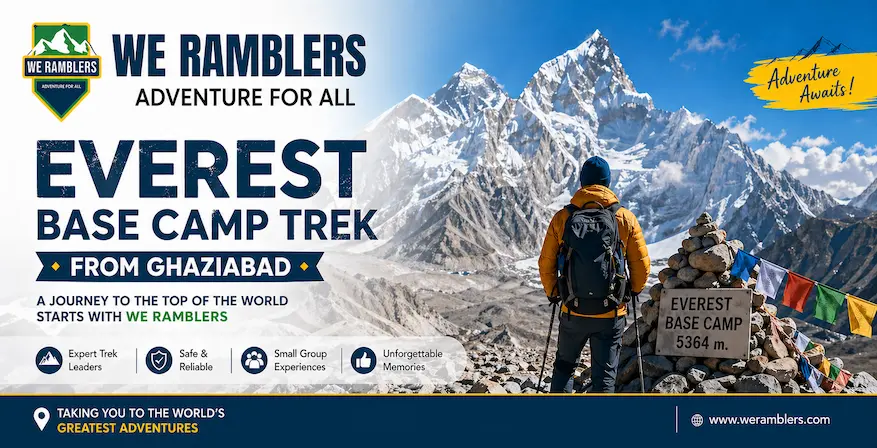
If you are sitting in Ghaziabad dreaming of standing at the foot of the world’s highest mountain, here is the truth: Everest Base Camp is closer to you than most people in the world. Ghaziabad is barely 30 km from Indira Gandhi International Airport in Delhi, and Kathmandu is under two hours away by air. The Everest Base Camp trek from Ghaziabad is not a logistical puzzle. With the right planning, it is a 16 to 18-day journey that begins at your doorstep and ends at 5,364 metres above sea level in the heart of the Khumbu Valley, Nepal.
Reach us at our India office: +91 9886274292 | Mail: trip@weramblers.com
How to Reach Kathmandu for the EBC Trek from Ghaziabad
Ghaziabad does not have its own commercial airport, but that is not an obstacle. Indira Gandhi International Airport (DEL) in New Delhi is roughly 32 km from Ghaziabad city centre and is your gateway to Nepal.
By Air (Recommended)
The fastest and most practical way to start your EBC trek from Ghaziabad is to take a cab or metro to IGI Airport, Delhi, and fly directly to Tribhuvan International Airport (KTM) in Kathmandu. The flight takes approximately 1 hour 25 minutes. Airlines including IndiGo, Air India, SpiceJet, and Himalaya Airlines operate this route with multiple daily departures. Round-trip airfares on this route typically range from INR 7,000 to INR 18,000 depending on how far in advance you book.
By Bus (Budget Option)
Several operators run direct overnight buses from Delhi’s Majnu Ka Tila bus terminal to Kathmandu. The journey takes approximately 28 to 30 hours and covers roughly 940 km via the Sunauli border crossing. Bus tickets cost between INR 2,000 and INR 3,500. This option suits trekkers on a strict budget or those who prefer a slower, overland introduction to the subcontinent’s landscapes before their high-altitude adventure begins.
By Train + Bus Combination
You can take a train from Ghaziabad Junction to Gorakhpur or Nautanwa (near the Sunauli border), then cross into Nepal and take a local bus or shared taxi to Kathmandu. This combination takes around 18 to 24 hours and is the most budget-friendly route, though it requires a bit more navigation.
Travel Tip: Indian nationals do not need a visa to enter Nepal. A valid passport, Aadhaar card, or voter ID card is sufficient for entry. A passport is strongly recommended for smoother processing and for obtaining trekking permits in the Khumbu region.
Everest Base Camp Trek from Ghaziabad: 14-Day Itinerary
This is the standard We Ramblers 14-day Everest Base Camp from Ghaziabad itinerary, beginning and ending in Kathmandu. Your total travel time from Ghaziabad adds 1 to 2 days on either end.
Day 1: Arrive in Kathmandu (1,400 m)
Your arrival and orientation day. WeRamblers will pick you up from Tribhuvan International Airport and transfer you to your hotel in Thamel, Kathmandu’s trekking hub. A group briefing takes place in the evening where your guides walk you through safety norms, permit logistics, and what to expect on the trail. If Lukla flights are routing via Ramechhap Airport (which happens during peak season due to Kathmandu congestion), you will be asked to prepare for an early 2 AM departure the next morning.
Day 2: Fly Kathmandu to Lukla, Trek to Phakding (2,652 m)
The 35-minute Kathmandu to Lukla flight is an adventure in its own right. You land at Tenzing-Hillary Airport, one of the world’s highest and most scenically dramatic airports at 2,860 m, with the Himalayas filling the horizon in every direction. From Lukla, the trek begins on a well-defined trail descending gently through forests and river valleys to Phakding. This first walking day takes 3 to 4 hours and serves as a good warm-up before the demanding ascent ahead.
Altitude: 2,652 m | Trek Duration: 3 to 4 hours
Day 3: Phakding to Namche Bazaar (3,440 m)
This is one of the most physically demanding days of the entire trek. You cross multiple suspension bridges over the Dudh Koshi River, pass through Monjo where you officially enter Sagarmatha National Park, and then face a steep 600-metre climb up to Namche Bazaar. The views open up progressively as you climb, and on a clear day, your first glimpse of Everest appears above the ridge line before you reach the town.
Namche Bazaar is the commercial and cultural capital of the Khumbu region, a horseshoe-shaped town at 3,440 m with bakeries, gear shops, a Sherpa cultural museum, and some of the best mountain views accessible from any town on earth.
Altitude: 3,440 m | Trek Duration: 5 to 6 hours
Day 4: Acclimatization Day in Namche Bazaar
One of two critical rest days on the itinerary. You stay at the same altitude but take a short hike up to the Everest View Hotel at approximately 3,880 m to help your body begin adjusting to lower oxygen levels. The principle here is “climb high, sleep low,” and it is the most important strategy for avoiding Acute Mountain Sickness (AMS) on this trek. You return to Namche for lunch and spend the rest of the day exploring the Sherpa Cultural Museum, local markets, and panoramic viewpoints.
Day 5: Namche Bazaar to Tengboche (3,867 m)
A beautiful day through pine and rhododendron forests, crossing a ridge with sweeping views of Ama Dablam before descending to the Dudh Koshi valley and climbing again to Tengboche. The trail passes through small Sherpa settlements and yak pastures. Tengboche is home to the famous Tengboche Monastery, the spiritual heart of the Khumbu. Many trekkers arrive in time for the evening prayer ceremony, which is one of the most atmospheric moments of the entire journey.
Altitude: 3,867 m | Trek Duration: 5 to 6 hours
Day 6: Tengboche to Dingboche (4,260 m)
The landscape begins to shift here. Forests thin out as you gain altitude, replaced by alpine meadows and open rocky slopes. The trail passes through Pangboche village with its ancient monastery before crossing the Imja Khola river and climbing steadily to Dingboche. On clear days, the views of Ama Dablam from this section of the trail are among the most photographed in the Himalayas.
Altitude: 4,260 m | Trek Duration: 5 to 6 hours
Day 7: Acclimatization Day in Dingboche
The second critical acclimatization day. Most trekkers hike up to Nagarjun Hill (5,083 m) for a 360-degree view that includes Makalu, the world’s fifth-highest peak, alongside Lhotse, Ama Dablam, and the Chukhung valley. Mild headaches or reduced appetite are common at this altitude and are normal signs of your body adjusting. Staying well hydrated and resting in the evening is important. The WeRamblers guide monitors trekkers with a pulse oximeter during these days to track blood oxygen saturation levels.
Day 8: Dingboche to Lobuche (4,910 m)
The trail follows the moraine of the Khumbu Glacier and passes through Dughla and the Trekkers’ Memorial at Thukla, a ridge lined with cairns and memorials to mountaineers who have lost their lives on Everest’s slopes. It is a sobering and deeply moving section of the trek. Lobuche is a small, exposed settlement with basic teahouses. Nights here are cold and sleep can be difficult at this altitude.
Altitude: 4,910 m | Trek Duration: 4 to 5 hours
Day 9: Lobuche to Gorak Shep, Trek to Everest Base Camp (5,364 m)
The highlight of the entire journey. You trek from Lobuche to Gorak Shep (5,164 m), leave your main pack at the lodge, and continue on to Everest Base Camp (5,364 m). The trail crosses rocky moraines and the edge of the Khumbu Glacier. Base Camp itself is marked by colourful expedition tents during climbing season (April to May), with the Khumbu Icefall towering above. Climbers preparing for Everest summit attempts are visible during spring departures.
The air at Base Camp is thin enough to make simple actions feel effortful, but the emotional reward of standing here, knowing what surrounds you, is unlike anything else in trekking. You return to Gorak Shep for the night.
Altitude: 5,364 m (EBC) | Trek Duration: 7 to 8 hours total
Day 10: Gorak Shep to Kala Patthar (5,545 m), Descend to Pheriche (4,240 m)
An early morning pre-sunrise start to summit Kala Patthar, the highest point of the standard EBC route at 5,545 m. The climb is steep but short, and the reward is a full, unobstructed view of Everest, Lhotse, Nuptse, Pumori, and Changtse as the first light turns the peaks golden. This is the single most iconic viewpoint of the entire trek. You then descend significantly to Pheriche, and with altitude dropping, most trekkers feel a noticeable improvement in energy and breathing.
Altitude: 5,545 m (Kala Patthar) | Trek Duration: 6 to 7 hours
Day 11: Pheriche to Namche Bazaar (3,440 m)
A long but energizing descent day. You cover the same terrain you climbed over several days, now moving fast in the other direction. The descent from above 4,000 m to 3,440 m brings a significant increase in oxygen and a lift in mood and physical energy that nearly every trekker comments on. You return to the warmth and energy of Namche Bazaar, which feels almost urban after the austere upper reaches of the route.
Trek Duration: 6 to 7 hours
Day 12: Namche Bazaar to Phakding or Lukla (2,652 m)
The final stretch of trail descent. You retrace the lower sections of the route through the pine forests, river valleys, and suspension bridge crossings that greeted you at the start of the trek. Depending on departure timing, the group stays either at Phakding or continues directly into Lukla for final preparations before the return flight.
Day 13: Fly Lukla to Kathmandu
The morning flight from Lukla back to Kathmandu provides one last aerial view of the Himalayan massif. The afternoon is free to explore Thamel, purchase souvenirs, celebrate at a restaurant, or rest. A group dinner and certificate ceremony typically takes place in the evening.
Day 14: Depart Kathmandu
Transfer to Tribhuvan International Airport for your flight back to Delhi. From IGI Airport, Ghaziabad is a 45-minute to 1.5-hour drive depending on traffic.
Reach us at our India office: +91 9886274292 | Mail: trip@weramblers.com
Everest Base Camp Trek Cost from Ghaziabad in 2026
Understanding the full cost breakdown helps you plan your budget without surprises. Here is a realistic figure-by-figure breakdown for a trekker departing from Ghaziabad.
We Ramblers Everest Base Camp Trek Package from from Ghaziabad
We Ramblers offers the Everest Base Camp trek starting at INR 60,000 per person** for Indian nationals. This is one of the most competitive rates in the market for a fully supported, guided trek. The package covers:
- Teahouse accommodation throughout the trek (twin sharing)
- All meals during the trek (breakfast, lunch, and dinner)
- A licensed and experienced Sherpa guide
- Porter service (1 porter for every 2 trekkers)
- Domestic flights from Kathmandu to Lukla and back
- Sagarmatha National Park entry permit
- Khumbu Pasang Lhamu Rural Municipality permit
- All Kathmandu airport transfers
What Is Not Included in the EBC Trek Package from Ghaziabad
- Your travel from Ghaziabad to Kathmandu (Delhi to Kathmandu flight, approximately INR 7,000 to INR 18,000 return)
- Travel insurance covering high-altitude trekking and helicopter evacuation (mandatory, approximately INR 3,000 to INR 7,000)
- Personal trekking gear (can be rented in Kathmandu at low cost)
- Tips for guides and porters (industry standard: USD 8 to USD 10 per day for the guide, USD 6 to USD 8 per day for the porter)
- Hot showers, Wi-Fi, and battery charging at teahouses (approximately INR 200 to INR 500 per use)
- Any extra snacks, drinks, or personal purchases on the trail
Total Estimated EBC Trek Cost from Ghaziabad (2026)
| Item | Estimated Cost (INR) |
|---|---|
| We Ramblers EBC package | Starting from 60,000 |
| Delhi to Kathmandu return flight | 9,000 to 18,000 |
| Travel insurance | 3,000 to 7,000 |
| Kathmandu hotel (pre/post trek) | 3,000 to 6,000 |
| Gear (rental or purchase) | 3,000 to 8,000 |
| Personal expenses on trail | 4,000 to 8,000 |
| Guide and porter tips | 3,000 to 5,000 |
| Total | INR 85,000 to INR 1,12,000 |
This is among the most cost-effective ways to complete the EBC trek with full professional support, particularly given that Indian nationals pay a reduced Sagarmatha National Park entry permit fee (NPR 1,500 versus NPR 3,000 for other nationalities) as a SAARC nation benefit.
EBC Trekking Permits Required in 2026
Two mandatory permits are required for the Everest Base Camp trek:
1. Sagarmatha National Park Entry Permit This permit is required for all trekkers entering the Khumbu region. Indian nationals pay NPR 1,500 (approximately INR 900). It can be obtained at the Nepal Tourism Board office in Kathmandu or at the park gate in Monjo. The WeRamblers team handles permit procurement as part of the package.
2. Khumbu Pasang Lhamu Rural Municipality Permit This replaced the old TIMS card in 2020. It costs approximately USD 20 per person (INR 1,650) and is collected at the entrance to the municipality, typically in Lukla or Monjo. This is also included in the WeRamblers package.
No visa is required for Indian nationals entering Nepal. A valid passport (recommended) or government-issued photo ID such as a voter ID card or Aadhaar card is sufficient.
Best Time for Everest Base Camp Trek from Ghaziabad
Spring Season: March to May
Spring is the most popular trekking window and one of the two best seasons for EBC. Temperatures are moderate, rhododendrons bloom in the lower forests between 2,000 and 4,000 m, and the days are long with excellent visibility. This is also when Everest climbing expeditions are active, which means you may see fully equipped climbing teams at Base Camp during April and May. March is quieter than April and offers the benefit of fewer trekkers on the trail.
Autumn Season: September to November
Autumn follows the monsoon and delivers some of the clearest skies and crispest mountain views of the year. October is widely considered the single best month for the EBC trek, combining stable weather, excellent visibility, and a festive atmosphere along the trail. November is slightly colder but still viable, with fewer crowds. Temperatures above 4,000 m can drop to -10°C to -15°C at night in November, so layering is critical.
When to Avoid
- June to August (Monsoon): The trail becomes muddy and leech-infested in the lower sections, and mountain views are frequently blocked by cloud cover. Landslides and flight disruptions are common.
- January to February (Deep Winter): Temperatures at Gorak Shep and above can fall to -25°C at night. The trail is passable but demanding, and teahouse infrastructure is limited as many lodges close for winter.
WeRamblers runs fixed departures every Saturday from March through May and September through December, allowing trekkers from Ghaziabad to align their travel plans with the best seasonal windows.
Altitude Sickness on the EBC Trek from Ghaziabad
Ghaziabad sits at approximately 200 metres above sea level. The jump to Lukla (2,860 m) on Day 2 and then to Namche Bazaar (3,440 m) on Day 3 represents a rapid change in altitude that your body is not naturally prepared for. Understanding Acute Mountain Sickness (AMS) and how to manage it is the single most important piece of preparation for the Everest Base Camp trek from Ghaziabad.
What Is AMS?
AMS occurs when the body ascends faster than it can adapt to reduced oxygen at high altitude. It can affect anyone, regardless of age, fitness, or prior trekking experience. According to published research in Wilderness and Environmental Medicine, approximately 40% of trekkers on the EBC route experience some symptoms of AMS.
Common early symptoms include:
- Persistent headache
- Fatigue and lethargy
- Nausea or vomiting
- Loss of appetite
- Difficulty sleeping
- Dizziness or lightheadedness
If these symptoms worsen or if new symptoms like confusion, loss of balance, or a crackling sound in the lungs appear, this may indicate High Altitude Cerebral Edema (HACE) or High Altitude Pulmonary Edema (HAPE), both of which are medical emergencies requiring immediate descent.
How to Prevent Altitude Sickness
- Never ascend above 3,000 m by more than 300 to 500 m per day. The WeRamblers itinerary is designed around this principle.
- Use acclimatization days properly. The rest days in Namche Bazaar and Dingboche are not optional; they are the structural backbone of a safe ascent. Use these days for short “climb high, sleep low” hikes to help the body adapt.
- Hydrate consistently. Drink 3 to 4 litres of water per day throughout the trek. Dehydration thickens the blood and impairs oxygen delivery to tissues.
- Avoid alcohol and smoking on the trail, as both reduce blood oxygen levels and dehydrate the body.
- Speak to your doctor about Diamox (Acetazolamide) before leaving India. This medication helps the body acclimatize by improving breathing at altitude. It should only be used under medical guidance.
- Eat regular meals. Appetite drops at altitude, but carbohydrate-rich foods like dal bhat, rice, porridge, and pasta provide consistent energy and aid acclimatization.
- Report symptoms to your guide immediately. The WeRamblers guides carry pulse oximeters and medical kits and are trained to respond to altitude emergencies.
Travel insurance that explicitly covers high-altitude trekking above 5,000 m and helicopter evacuation is mandatory for all WeRamblers EBC treks. Emergency helicopter evacuations from the Khumbu region are expensive and this coverage protects you from significant financial risk.
What to Pack for the Everest Base Camp Trek from Ghaziabad
You do not need to buy everything new before your trip. Gear can be purchased or rented affordably in Kathmandu’s Thamel neighbourhood. Here is a practical packing list organized by category:
Clothing and Layering
- Moisture-wicking base layers (merino wool or synthetic)
- Mid-layer fleece or down jacket
- Waterproof outer shell jacket and trousers
- Insulated down jacket (essential above 4,000 m)
- Trekking trousers (2 pairs)
- Warm hat, sun hat, buff or neck gaiter
- Liner gloves and insulated waterproof gloves
- Wool trekking socks (4 to 5 pairs)
- Thermal underwear
Footwear
- Sturdy, waterproof trekking boots (broken in before the trek)
- Camp sandals or flip-flops for evenings at teahouses
- Gaiters (optional but useful in winter months)
Gear
- 50 to 60L trekking backpack and a 15 to 20L day pack
- Trekking poles (strongly recommended for descents and knee support)
- Sleeping bag rated to -15°C or lower
- Headlamp with extra batteries
- Sunglasses with UV400 or higher protection
- Sunscreen SPF 50+ and lip balm with SPF
Health and Safety
- Pulse oximeter
- Personal first aid kit
- Water purification tablets or a portable filter
- Altitude sickness medication (Diamox, as prescribed by a doctor)
- Electrolyte powder or ORS packets
- Prescription medications if applicable
Documents and Essentials
- Passport (original plus a photocopy)
- Travel and trekking insurance documents
- Emergency contact details
- Local currency (Indian Rupees can be exchanged for Nepali Rupees at banks and official money changers in Kathmandu)
Fitness Preparation for Ghaziabad Trekkers
The EBC trek involves 5 to 7 hours of walking per day for up to 12 consecutive days, at altitudes where every step requires more effort than it would at sea level. You do not need to be an athlete, but you do need to prepare.
A 12-Week Training Plan
Weeks 1 to 4 (Foundation) Focus on cardiovascular fitness. Walk 5 to 8 km daily on flat terrain. Add 2 sessions per week of cycling or swimming. Begin stair climbing at home or in your apartment building to simulate the constant uphill and downhill gradient of the EBC trail.
Weeks 5 to 8 (Building Endurance) Increase walking distance to 10 to 15 km, 4 to 5 days per week. Add a backpack weighing 7 to 10 kg to simulate trekking conditions. Where possible, trek on uneven terrain. If you can reach hill stations like Mussoorie or Chakrata from Ghaziabad for a weekend trail run, take that opportunity.
Weeks 9 to 12 (Trek Simulation) Complete at least two back-to-back long walk days (15+ km each day) in consecutive days with a full backpack. This simulates the accumulated fatigue of multi-day trekking. Focus on knee strength and stability with exercises like squats, lunges, and leg presses.
Ghaziabad-Specific Tip: The Hindon River bank and Sanjay Van Park in neighbouring Delhi are good walking spots. The steep ghats at Vaishno Devi or a weekend trek in the Himachal foothills closer to the trek date would serve as excellent physical preparation.
Cultural Highlights on the EBC Trail from Ghaziabad
The Everest Base Camp trek from Ghaziabad is not just a physical journey; it is a cultural immersion into one of the most distinct communities on earth.
Sherpa Villages and Hospitality
The Sherpa people are the original inhabitants of the Khumbu region. Their Buddhist traditions, oral histories, and deep connection to the mountains shape the atmosphere of every village you pass through. Teahouses are family-run operations where the same families have been hosting trekkers for generations. The warmth and sincerity of Sherpa hospitality is one of the most consistently mentioned highlights in trekker accounts of this route.
Tengboche Monastery
Sitting at 3,867 m against a backdrop of Ama Dablam and the upper Khumbu peaks, Tengboche Monastery is the largest and most spiritually significant in the Everest region. Evening prayer ceremonies are open to trekkers and provide a rare window into the living Buddhist traditions of this community.
Mani Walls, Chortens, and Prayer Flags
The entire trail is lined with mani walls, carved stone chortens, and thousands of prayer flags in five colours: blue (sky), white (wind), red (fire), green (water), and yellow (earth). These are not decorative features; each element carries deep spiritual meaning. The traditional respect is to walk clockwise around these sacred structures when you encounter them. Your WeRamblers guide explains these customs throughout the trek.
The Namche Bazaar Sherpa Cultural Museum
During your acclimatization day in Namche, the Sherpa Cultural Museum is worth an hour of your time. It details the history of the region, early expeditions including Sir Edmund Hillary and Tenzing Norgay’s 1953 first ascent, and the cultural and economic history of the Sherpa community.
Why Choose We Ramblers for Your Everest Base Camp Trek from Ghaziabad
We Ramblers is an adventure travel company with offices in Kathmandu, Nepal, and Bangalore, India. The company has been organizing Everest Base Camp treks for trekkers across India and the world, and holds a 4.9-star rating based on verified Google reviews.
What makes WeRamblers the right partner for the EBC trek from Ghaziabad:
- India-based logistics and coordination: You deal with an Indian-facing team before departure, which means WhatsApp communication, Indian Rupee pricing, and full pre-trek support in familiar formats.
- Licensed Sherpa guides: All We Ramblers guides hold Nepal government trekking guide licenses and are trained in wilderness first aid and altitude emergency response.
- Fixed and transparent pricing: The package has no hidden charges. The full list of inclusions and exclusions is communicated clearly at the time of booking.
- Small group sizes: We Ramblers prioritizes smaller group departures, which allows for better guide-to-trekker ratios and more personalized pacing and safety management.
- Medical preparedness: Guides carry pulse oximeters, supplemental oxygen, and emergency medical kits on every departure. All WeRamblers itineraries include mandatory acclimatization days.
- Departure frequency: Weekly fixed departures from March to May and September to December mean you can choose a date that fits your schedule from Ghaziabad.
Contact WeRamblers for the EBC trek from Ghaziabad:
- Phone/WhatsApp: +91 9886274292
- Email: trip@weramblers.com
Everest Base Camp Trek Difficulty: Is It Right for You?
The EBC trek is rated moderate to difficult. It does not require technical climbing skills, ropes, or mountaineering experience. What it demands is:
- Cardiovascular endurance for 5 to 7 hours of sustained walking each day
- Mental resilience on days when the altitude creates fatigue, headaches, or low appetite
- Physical preparation through consistent training in the 2 to 3 months before the trek
WeRamblers has guided trekkers of all ages and backgrounds to Base Camp, including first-timers, professionals with desk jobs, trekkers in their 60s, and families. The key differentiator between those who complete the trek and those who turn back is not fitness level alone; it is preparation, respect for the altitude, and honest communication with their guide.
If you can currently walk 10 km on flat terrain without significant difficulty and are willing to invest 10 to 12 weeks in consistent fitness training, the EBC trek from Ghaziabad is within your reach.
Frequently Asked Questions: Everest Base Camp Trek from Ghaziabad
Do I need a visa to go to Nepal for the Everest Base Camp trek from Ghaziabad?
No. Indian nationals enjoy visa-free entry to Nepal. A valid passport is recommended for the smoothest border crossing and for obtaining trekking permits. A voter ID card or Aadhaar card is technically sufficient for entry, but a passport avoids complications with permit documentation.
How much does the Everest Base Camp trek cost from Ghaziabad in 2026?
The total all-in cost typically ranges from INR 85,000 to INR 1,12,000 per person, which includes the WeRamblers package (starting at INR 60,000), your Delhi to Kathmandu return flight, travel insurance, personal gear, tips, and spending money on the trail.
How many days does the EBC trek take from Ghaziabad?
The standard WeRamblers 14-day itinerary begins and ends in Kathmandu. Adding 1 day for travel from Ghaziabad to Kathmandu and 1 day for the return journey gives a total trip duration of 16 to 17 days.
What is the best time for the Everest Base Camp trek from Ghaziabad?
Spring (March to May) and autumn (September to November) are the two ideal seasons. October is widely regarded as the single best month for the EBC trek due to post-monsoon clarity and stable weather.
Is the EBC trek safe for first-time trekkers from India?
Yes, provided you choose a responsible operator, follow a proper acclimatization itinerary, and carry travel insurance. WeRamblers has an established track record of guiding first-time Indian trekkers safely to Everest Base Camp and back.
Can I do the Everest Base Camp trek from Ghaziabad without a guide?
For trekkers from Ghaziabad undertaking the EBC route for the first time, a licensed guide significantly improves safety outcomes, logistical smoothness, and the quality of the cultural experience. The cost difference is minimal relative to the benefit.
How do I get from Ghaziabad to Kathmandu?
The most practical option is to travel to Indira Gandhi International Airport in Delhi (approximately 32 km from Ghaziabad) and take a direct flight to Kathmandu. The flight takes around 1 hour 25 minutes and return tickets typically cost INR 7,000 to INR 18,000.
What permits are needed for the EBC trek from Ghaziabad?
Two permits are required: the Sagarmatha National Park Entry Permit (NPR 1,500 for Indian nationals) and the Khumbu Pasang Lhamu Rural Municipality Permit (approximately USD 20). Both are included in the WeRamblers package fee.
Is altitude sickness a serious concern for trekkers from Ghaziabad?
Yes, and it should be taken seriously. Ghaziabad sits at roughly 200 m above sea level, which means your body is entirely unaccustomed to the thin air above 3,000 m. Following the acclimatization schedule, staying hydrated, and communicating symptoms to your guide immediately will keep you safe. WeRamblers guides carry pulse oximeters and emergency oxygen on all departures.
What currency should I carry for the EBC trek from Ghaziabad?
The official currency of Nepal is the Nepalese Rupee (NPR). Indian Rupees (INR) can be exchanged for NPR at official money changers in Kathmandu and Namche Bazaar. The exchange rate is approximately 1.6 NPR per INR. ATMs are available in Kathmandu and Namche Bazaar. Above Namche, cash is the only accepted payment method.
Ready to Trek? Book Your Everest Base Camp Trek from Ghaziabad Today
The Everest Base Camp trek from Ghaziabad is more accessible than most people realize. You are less than two hours by air from Kathmandu, Indian nationals need no visa to enter Nepal, and We Ramblers offers a fully structured, transparent, India-friendly package starting at INR 60,000.
Spring 2026 departures are currently available every Saturday from March through early June. Autumn 2026 departures run from September through December. Group sizes are small, guides are licensed and experienced, and every detail from permits to porters is handled for you.
We also offer EBC trek packages from Mumbai, Delhi, Kolkata, Chennai, and other Indian cities.
To book your spot or speak to a trekking expert:
Call/WhatsApp: +91 9886274292 | Email: trip@weramblers.com | Book Online: weramblers.com/nepal/everest-base-camp-trek
Do not wait for the perfect moment. The mountain is not going anywhere. Your preparation starts today.
This article was written by the We Ramblers team. We Ramblers is an adventure travel company with offices in Kathmandu, Nepal, and Bangalore, India, specializing in Himalayan trekking including the Everest Base Camp trek, Annapurna Circuit, Manaslu Circuit, and peak climbing expeditions across Nepal, Tibet, and Bhutan.