
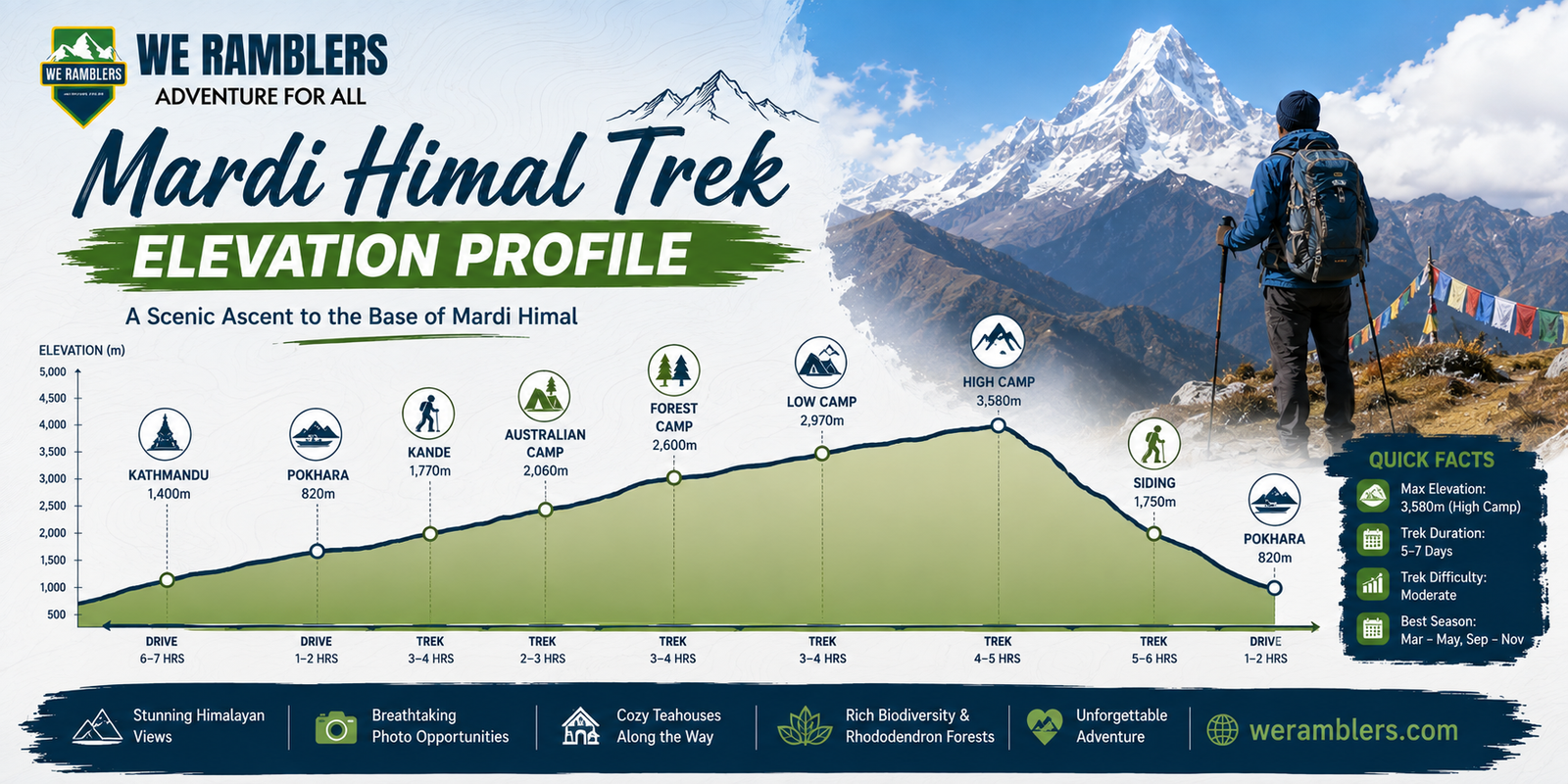
Understanding the elevation profile of the Mardi Himal Trek is one of the best ways to prepare for the trip, since the altitude gain shapes everything from your daily pace to your acclimatization plan. This guide walks through the full altitude progression, camp by camp, so you know exactly what to expect as you climb from the lowlands near Pokhara to the high ridge above the tree line.
Starting Point: Kande
The Mardi Himal Trek begins at Kande, a small village reached by a short drive from Pokhara, sitting at approximately 1770 meters above sea level. Starting the trek at this relatively high elevation is one reason Mardi Himal feels quicker to climb than routes that begin much closer to sea level, since trekkers skip a large portion of the low altitude forest walking found on longer treks.
Kande to Pothana and Pitam Deurali
From Kande, the trail climbs steadily through forested ridgeline to Pothana, sitting around 1890 meters, before continuing on to Pitam Deurali at approximately 1990 to 2060 meters. This section is considered one of the gentler parts of the trek, with a gradual gradient that eases trekkers into the climb ahead.
Pitam Deurali to Forest Camp
The trail from Pitam Deurali to Forest Camp involves a more noticeable elevation gain, climbing through dense rhododendron and oak forest to reach approximately 2500 to 2600 meters. Many itineraries schedule an overnight stop here, since this is roughly the point where trekkers begin to notice thinner air and cooler temperatures, along with improving views of Machapuchare through breaks in the tree cover.
Forest Camp to Low Camp
Continuing upward, the trail moves from Forest Camp to Low Camp, reaching an elevation of approximately 2970 to 2985 meters. The forest starts to thin out considerably along this stretch, and mild altitude effects such as light headaches or tiredness can begin to appear for some trekkers, though these are usually manageable with a steady pace and proper hydration.
Low Camp to Badal Danda and High Camp
From Low Camp, the trail passes through Badal Danda at around 3210 meters before reaching High Camp at approximately 3550 to 3580 meters. This stretch marks the transition out of the tree line into more exposed alpine terrain, and it is widely regarded as one of the more demanding sections of the entire route due to the steep, rocky trail and the cumulative effect of altitude gain. High Camp itself is where most itineraries schedule the final overnight stop before the summit push, since sleeping here keeps trekkers at a manageable altitude ahead of the last climb.
High Camp to Mardi Himal Viewpoint and Base Camp
The final stage of the trek covers the most altitude in the shortest distance. From High Camp, the trail follows a narrow ridge to the Upper Viewpoint at approximately 4200 meters, and from there continues on to Mardi Himal Base Camp at around 4500 meters, the highest point on the standard itinerary. This section is exposed to wind and thin air, and while it does not require any technical climbing skill, it is the most physically demanding stretch of the trek, particularly for trekkers who have not paced themselves earlier in the itinerary.
Total Elevation Gain
Across the full route, trekkers gain approximately 2730 meters in net elevation, climbing from Kande at 1770 meters to the highest point near 4500 meters. This gain is spread across roughly 5 to 7 days on the standard itinerary, following the mountaineering principle of climbing high and sleeping low wherever possible to reduce altitude sickness risk.
Descent and Return Route
Many itineraries do not retrace the exact ascent route on the way down. Instead, trekkers often descend from High Camp or Low Camp toward Siding village, sitting at approximately 1700 meters, before continuing back toward Pokhara. This route creates a steep, knee testing descent, and trekking poles are strongly recommended to reduce strain on the joints during this stretch.
Why the Elevation Profile Matters for Planning
Since Mardi Himal reaches an altitude comparable to or higher than the Annapurna Base Camp Trek in a shorter overall timeframe, the elevation gain per day tends to feel steeper. Trekkers coming from longer, more gradual routes such as the Everest Base Camp Trek should be aware that Mardi Himal compresses a similar altitude range into fewer days, which places more importance on a steady pace and proper hydration throughout the climb.
Tips for Managing the Elevation Gain
- Avoid rushing between camps, even on shorter walking days, since altitude effects can build gradually.
- Drink plenty of water throughout each day to help offset the effects of thinner air.
- Consider an extra night at Low Camp or High Camp if you notice any symptoms of altitude sickness before pushing higher.
- Pack warm layers for High Camp and above, since temperatures drop noticeably once you clear the tree line.
- Use trekking poles on both the steep ascent near High Camp and the fast descent toward Siding village.
Plan Your Mardi Himal Trek With We Ramblers
Knowing the elevation profile in advance helps you prepare mentally and physically, but having an experienced guide manage your daily pace is what actually keeps the climb safe and enjoyable. Our team at We Ramblers has led trekkers up this route many times and structures each itinerary around sensible acclimatization rather than rushing toward the top.
Get in touch through our contact page to start planning your Mardi Himal Trek, or explore our full range of trekking packages if you are still comparing routes in the Annapurna region.
Frequently Asked Questions About Mardi Himal Trek Elevation
What is the starting elevation of the Mardi Himal Trek?
The trek begins at Kande, which sits at approximately 1770 meters above sea level, reached by a short drive from Pokhara.
What is the highest point on the Mardi Himal Trek?
The highest point is Mardi Himal Base Camp at approximately 4500 meters, though many trekkers also stop at the Upper Viewpoint around 4200 meters.
What is the elevation of High Camp on the Mardi Himal Trek?
High Camp sits at approximately 3550 to 3580 meters and is typically the last overnight stop before the final push toward the viewpoint or base camp.
How much total elevation do you gain on the Mardi Himal Trek?
Trekkers gain approximately 2730 meters in net elevation, climbing from Kande at 1770 meters to the highest point near 4500 meters.
Which section of the trek has the steepest elevation gain?
The climb from Low Camp through Badal Danda to High Camp, along with the final push from High Camp to the viewpoint, are generally considered the steepest and most demanding sections.
Do you sleep at the highest point of the trek?
No, most itineraries keep the overnight stop at High Camp around 3550 to 3580 meters, with the push to the higher viewpoint or base camp completed as a day trip.