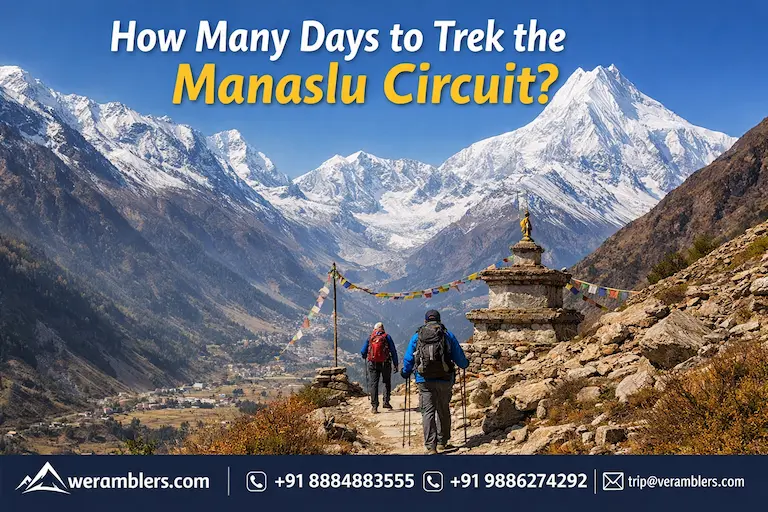
If you’ve been dreaming about a raw, crowd-free Himalayan adventure, the Manaslu Circuit Trek belongs at the very top of your list. Circling the world’s eighth-highest peak, Mount Manaslu at 8,163 metres, this stunning route through the Gorkha district of Nepal delivers ancient Tibetan-Buddhist culture, staggering mountain panoramas, and the kind of wilderness that’s quietly disappearing from most of the Himalayas.
But before you lace up your boots, one question dominates every planning conversation: how many days to trek the Manaslu Circuit do you actually need? The honest answer depends on your fitness, your goals, and how much of this extraordinary landscape you want to absorb. In this complete Manaslu Circuit guide from We Ramblers, we break it all down.
The Quick Answer: How Many Days to Trek the Manaslu Circuit?
If you’re asking “How Many Days to Trek the Manaslu Circuit“, here the quick answer: Most trekkers complete the core Manaslu Circuit in 11 to 16 days of walking, starting from Machha Khola (or Soti Khola) and finishing at Dharapani, where the route merges into the Annapurna region. Factor in two days of road travel from Kathmandu at each end, and your total Nepal trip runs to 14 to 20 days.
Add the optional Manaslu Base Camp trek or the Tsum Valley extension, and you’re looking at 18 to 22+ days. Here’s a simple breakdown of the most popular options:
| Duration | What’s Included | Best For |
|---|---|---|
| 11–12 days | Core circuit, Larkya La Pass | Experienced trekkers, tight schedules |
| 14–16 days | Core circuit + acclimatisation + Base Camp side trip | Most trekkers — our recommended sweet spot |
| 18–22+ days | Full circuit + Tsum Valley | Those wanting the complete Manaslu experience |
Manaslu Circuit Trek Distance: How Far Are You Actually Walking?
Before you count the days, understand the distance. The Manaslu Circuit Trek distance covers approximately 177 km (around 110 miles) — notably longer than the Everest Base Camp trail at roughly 130 km. The Manaslu Circuit Trek map traces the full loop of Mount Manaslu, following the Budhi Gandaki River valley northward from Machha Khola, climbing through subtropical forests, traditional Gurung and Magar villages, and into dramatic high-alpine terrain near the Tibetan border. The route exits via the legendary Larkya La Pass at 5,106 metres before descending into the Annapurna Conservation Area at Dharapani.
On a standard schedule, trekkers cover 12–18 km per day, with daily walking times of 6 to 8 hours. The Larkya La crossing day is the exception — expect a pre-dawn start and a full 8 to 10 hours on the mountain.
The Recommended 14–16 Day Manaslu Circuit Trek Itinerary
For most people asking “how many days to trek the Manaslu Circuit“, 14 to 16 days is the answer that best balances safety, acclimatization, and real exploration. Here’s what that looks like on the ground:
Days 1–2 — Drive to Trailhead: Kathmandu to Machha Khola is a long 8 to 10-hour drive on a mix of paved road and rough jeep track. Begin trekking toward Jagat as the Budhi Gandaki gorge opens up around you.
Days 3–5 — Into the Gorge: Trek through Jagat, Deng, and Namrung, crossing suspension bridges over roaring rivers and passing mani walls, water-powered prayer wheels, and dense rhododendron forest. The culture begins to shift visibly toward Tibetan-Buddhist influences.
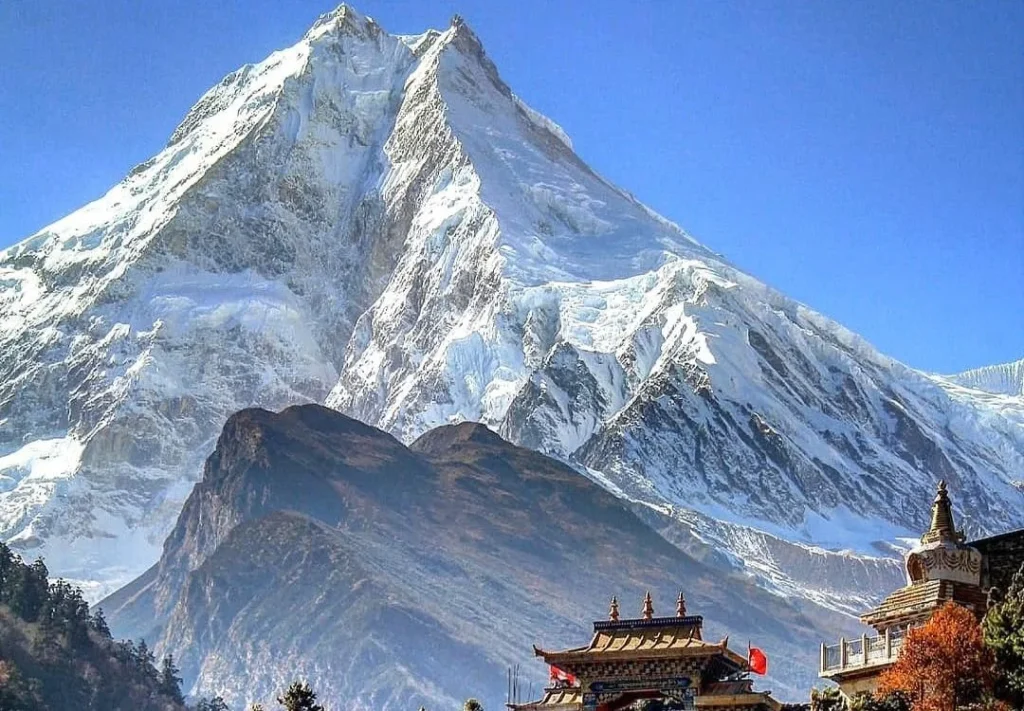
Days 6–7 — First Views of Manaslu: Reach the village of Lho, where Mount Manaslu first reveals itself in full above the Rebung Gompa monastery — one of the great “wow” moments of the entire route. Continue to Samagaon (3,450 m), the last major village before the high route.
Day 8 — Acclimatisation at Samagaon: Non-negotiable. Use it for a hike to the Pungyen Gompa or a day trip to Manaslu Base Camp at 4,800 m — a brilliant “climb high, sleep low” strategy that dramatically reduces altitude sickness risk.
Day 9 — Samdo: A gentle walk to Samdo (3,875 m), a remote settlement sitting just 8 km from the Tibetan border.
Day 10 — High Camp: Short climb to Dharamsala / Larkya La Phedi (4,480 m), your launching point for the pass.
Day 11 — Larkya La Pass (5,106 m): The headline act. Set off before dawn, climb to the highest point on the route, and descend to Bhimthang (3,720 m). The summit panorama — Himlung Himal, Cheo Himal, Kang Guru, Annapurna II — is one of the finest in the Nepal Himalayas. Crampons are advisable in early season.
Days 12–14 — The Descent: Through Bhimthang and Tilche, the landscape transitions dramatically from alpine tundra back to lush subtropical forest. Reach Dharapani and the circuit’s end.
Days 15–16 — Return to Kathmandu: Jeep or local bus via Besisahar back to Kathmandu or Pokhara.
Can You Do It Faster? The 11–12 Day Option
Fit, experienced trekkers with prior high-altitude time regularly complete the core route in 11 to 12 days by combining longer daily stages and skipping optional side trips. It’s achievable — but speed and altitude are a dangerous combination. You’re ascending from roughly 700 m at Machha Khola to 5,106 m at the pass, and altitude sickness does not care how fit you are.
At We Ramblers, we never recommend cutting acclimatization days to save time. Those rest days aren’t padding — they’re what keep you safe and keep your trek on track.
Is Manaslu Harder Than Everest Base Camp?
It’s one of the most Googled questions in Nepal trekking, and the answer is nuanced. The EBC trek is primarily an altitude challenge, keeping you consistently above 3,500 m and topping out at Kala Patthar (5,545 m). The Manaslu Circuit is more of an endurance and remoteness challenge — at 177 km vs 130 km, with rougher terrain, less infrastructure, and a long single-push pass crossing that EBC simply doesn’t have.
Most experienced guides rate the Manaslu Circuit as slightly more demanding overall, though it tops out lower than EBC, which reduces the risk of severe altitude sickness. The other major difference is solitude: EBC sees upward of 60,000 trekkers annually; Manaslu sees fewer than 12,000. That gap changes everything about how a trek feels.
As for how hard the Manaslu summit itself is — that’s a completely different world. The 8,163 m summit is a serious technical mountaineering objective with significant objective hazards, attempted only by experienced high-altitude climbers on a full expedition permit. The trekking route around the mountain shares nothing in difficulty with the climbing route above.
Manaslu Circuit Trek Permits: Why You Can’t Trek Solo
The Manaslu region is a Restricted Area under Nepali law, which is the main reason it remains so pristine. Solo trekking is not permitted — you must be in a group of at least two with a licensed local guide, booked through a registered agency. Three permits are required:
- Manaslu Restricted Area Permit (MRAP): USD 100/person for the first seven days in peak season (Sept–Nov); USD 75 in off-season — plus daily fees after that.
- Manaslu Conservation Area Permit (MCAP): USD 30/person.
- Annapurna Conservation Area Permit (ACAP): USD 30/person (required on exit via Dharapani).
We Ramblers handles all permit logistics, so you arrive ready to walk.
Best Time to Go
Autumn (October–November) is the undisputed prime season — stable weather, clear skies, and a reliably snow-free Larkya La. Spring (March–May) is a close second, with blooming rhododendrons in the lower valleys and warm days, though some snowfall at the pass remains possible in March. Avoid the monsoon (June–August) entirely — landslides in the Budhi Gandaki gorge are a serious risk.
Should You Add the Manaslu Base Camp Trek?
Yes — without hesitation. The Manaslu Base Camp trek is done as a day hike from Samagaon during your scheduled acclimatization day, so it adds zero extra walking days to your itinerary. From base camp at 4,800 m, the south face of Manaslu fills the sky — an intimate, humbling close-up of an 8,000-metre giant that no photograph quite captures. The nearby Birendra Lake, shimmering and turquoise at altitude, is another highlight worth every step.
Plan Your Trek with We Ramblers
So, how many days to trek the Manaslu Circuit? Our answer is always the same: don’t rush it. Give yourself 14 to 16 days on the trail, take your acclimatization seriously, do the Base Camp side trip, and let this extraordinary mountain landscape work on you properly.
We Ramblers runs small-group and private Manaslu Circuit departures throughout spring and autumn, with full permit handling, licensed local guides, and carefully selected teahouse accommodation all along the route.
Start planning your Manaslu Circuit Trek
Frequently Asked Questions: How Many Days to Trek the Manaslu Circuit?
1. How many days to trek the Manaslu Circuit for a complete beginner?
If this is your first high-altitude trek, we strongly recommend the full 16-day itinerary — and honestly, even stretching it to 18 days if your schedule allows. Beginners need additional time to adjust to altitude, recover from longer walking days, and simply enjoy the experience without feeling physically broken by it. Prior training with loaded day hikes over several weeks before departure makes a significant difference. The Manaslu Circuit is not a beginner-friendly trek in the traditional sense, but with the right preparation and adequate time, determined first-timers absolutely complete it every season.
2. What is the highest point on the Manaslu Circuit Trek?
The highest point on the trekking route is the Larkya La Pass at 5,106 metres (16,752 feet). This is the crux of the entire circuit and the day most trekkers find both the most demanding and the most rewarding. If you add the optional Manaslu Base Camp side trip, you’ll reach approximately 4,800 metres — lower than the pass itself. The Larkya La crossing typically takes 8 to 10 hours including the descent to Bhimthang, so an early alpine start (often 3–4 AM) is standard practice.
3. Do I need a guide for the Manaslu Circuit Trek?
Yes — and this is a legal requirement, not just a recommendation. Because the Manaslu region is a government-designated Restricted Area, solo trekking is prohibited. You must trek in a group of at least two people and be accompanied by a licensed local guide arranged through a registered Nepali trekking agency. Attempting the route without the correct permits and guide not only puts you at legal risk but also means you’ll be turned back at checkpoints along the trail. At We Ramblers, our guides are deeply experienced on this specific route and add enormous value — from navigating trail junctions to managing altitude-related concerns.
4. How fit do I need to be for the Manaslu Circuit?
The Manaslu Circuit Trek demands a solid baseline of cardiovascular fitness and the mental stamina for consecutive long walking days. You should be comfortable walking 6 to 8 hours per day on uneven, often steep terrain, carrying a daypack of 6 to 10 kg. In the months before your trek, focus on building leg strength and aerobic endurance — hiking with elevation gain, stair climbing, cycling, and long weekend walks with a loaded pack are all excellent preparation. Prior experience at altitude (above 3,500 m) is a definite advantage but not a strict requirement if your itinerary includes proper acclimatisation days.
5. What is the best season for the Manaslu Circuit Trek?
The two optimal windows are October to November (autumn) and March to May (spring). Autumn is widely considered the best season overall — post-monsoon skies are crystal clear, temperatures are stable, and the Larkya La Pass is reliably snow-free. October in particular offers near-perfect trekking conditions. Spring is equally beautiful, with rhododendron forests blazing in colour through the lower valleys, though there is a slightly higher chance of snowfall at the pass in March. Avoid June through September entirely — monsoon rains bring heavy landslide risk in the Budhi Gandaki gorge section of the route.
6. Can I combine the Manaslu Circuit with the Annapurna Circuit?
Yes, and it makes for one of the greatest trekking combinations in Nepal. Since the Manaslu Circuit Trek exits at Dharapani — which sits directly on the Annapurna Circuit — a combined itinerary flows naturally. Most trekkers who go this route complete the Manaslu Circuit first (finishing at Dharapani), then continue onto the Annapurna Circuit toward Manang, Thorong La Pass, and Pokhara. The full combined trek typically takes 25 to 30 days and covers two of Nepal’s most spectacular trekking regions back to back. Bear in mind that you’ll need separate permits for both conservation areas, and the overall physical and logistical demands are considerably higher — but the reward is unmatched.
7. How much does the Manaslu Circuit Trek cost in total?
Total costs vary depending on the style of trek, group size, and season, but as a rough guide, budget USD 1,200 to USD 2,000 per person for a fully guided, permit-inclusive package through a reputable agency. This typically covers all mandatory permits (MRAP, MCAP, ACAP), a licensed guide, a porter, teahouse accommodation, and most meals on the trail. International flights, travel insurance (mandatory and must cover high-altitude evacuation), and personal gear are additional. Cutting costs by going with under-registered agencies or attempting to bypass the restricted area permit system is not worth the risk — both legally and in terms of your safety on the mountain.