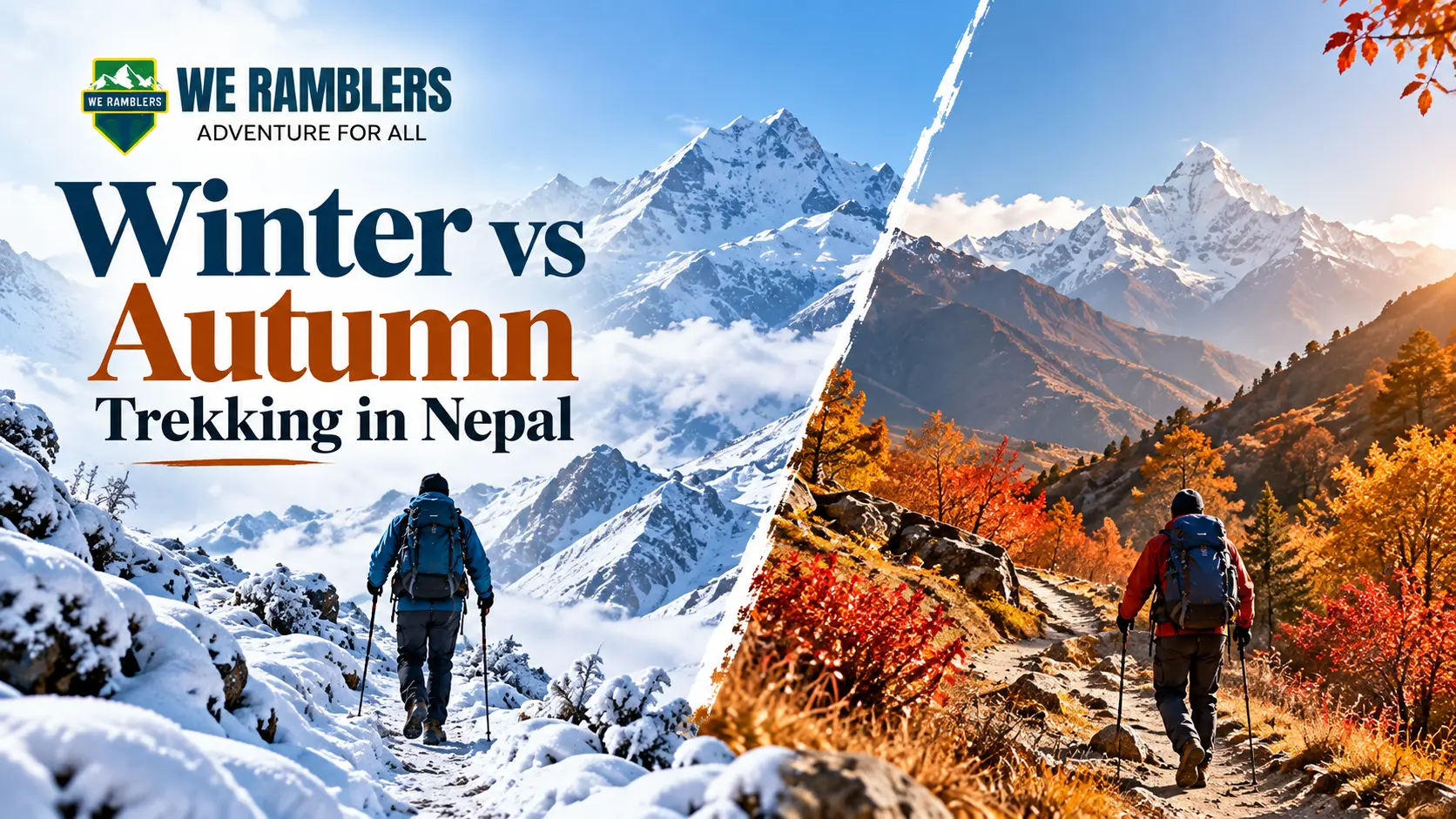
Are you wondering which season would be better for your Nepal trek – winter or autumn? Generally speaking, for your winter vs autumn trekking in Nepal, autumn (September to November) implies more stable weather conditions and a larger number of trekking routes available. On the other hand, winter (December to February) will mean lower temperatures, yet the trails will be less crowded, while the mountains themselves will enjoy a greater peace. Each season has its own advantages, and the choice ultimately depends on your needs.
Of course, there are some nuances involved. Weather conditions in Nepal significantly depend on the altitude. So, for example, December in Pokhara and Everest Base Camp can mean quite different things. Speaking broadly, you should know that for every 1,000 metres increase in altitude, the temperature decreases by about 6°C, following Nepal Tourism Board recommendations. So, the location plays an equally important role as the season itself.
In this article, we will compare winter and autumn seasons in detail, providing information on the weather, the number of tourists, trail conditions and prices per month.
A quick note before we begin: Spring (March to May) and Monsoon (June to August) are considered as Nepal’s other two trekking windows. We are focused on Winter vs Autumn Trekking here, but we will bring them into comparison when it would be useful.
Quick Answer: Autumn vs Winter Trekking in Nepal at a Glance
Autumn (from September to November) is considered the peak period for trekking in Nepal, as the weather is stable and the visibility of the mountain ranges is crystal-clear. Winter (from December to February), being very cold and covered in snowfall in the higher passes, becomes a better choice only for lower altitude routes.
Climate and Temperature
Autumn: The temperature during daytime usually is 15–24° C. It’s sunny, and the chances of rain are minimal after the end of the monsoon period.
Winter: The temperature decreases, nights are far below zero degrees Celsius in the higher altitudes, and strong winds often accompany winter days.
Trails and Accessibility
Autumn: The trails are dry and safe; all trails are open for walking, even passes over 5,000 metres high such as Thorong La.
Winter: Trails higher than 5,000 metres are often blocked with snow. Trekking comfortably becomes possible up to 3,500–4,000 metres, like on Poon Hill or Mardi Himal.
Crowds and Solitude
Autumn: Paths are full of crowds, tea houses get booked out quickly, and trekking paths such as the Everest Base Camp Trek and Annapurna Circuit are very crowded.
Winter: Paths give some of the most peaceful walking opportunities of the year, but some higher altitude tea houses are closed for the winter season.
Scenery and Visibility
Autumn: Clear air after the monsoon season offers great visibility and beautiful panoramas of mountains.
Winter: Bright and clear skies during the day, although heavy snowfall might restrict visiting of certain high altitude viewpoints and sidetracks.
Nepal Trekking Seasons: What’s the Real Difference Between Winter and Autumn?
| Factor | Autumn (Sep-Nov) | Winter (Dec-Feb) |
| Weather | Remains dry, and gets clear after monsoon | Generally Cold and Dry. Clear on good days. |
| Daytime Temperature | Temperature remains roughly 15-24°C at lower altitudes | Freezing at night and cold even by day at higher elevations. |
| Mountain Visibility | Excellent – You will get the clearest skies of the year | Also excellent on clear days, and sometimes even sharper. |
| High Passes (5000m+) | Fully Open, including Thorong La | Frequently snow-blocked and closed |
| Crowds | Huge, specially in October | Light, it becomes some of the calmest trails of the year |
| Train Elevation Limits | No Such Restriction | Comfortable Trekking which stays below 3,500 to 4,000m |
| Teahouses | Busy, so prior booking in advance is needed | Many higher altitude lodges close for the season |
| Good For | First time trekkers, classic routes , photography | Trekkers who can tolerate cold, lower routes, and solitude |
Trekking Season Nepal Explained: How Autumn and Winter Actually Feel on the Trail
Autumn Trek in Nepal: September to November
The autumn season starts once the monsoon rainfall subsides. It makes a huge difference in the trails since the rains cleanse the dust and smog in the atmosphere, giving clearer views of the mountains. In late September, most of the trails are dry, rivers have slowed down, and the scenery is much better compared to the rainy seasons.
October is the ideal month to go hiking because of the good weather and minimal rainfall. The weather is ideal for taking in views of Mount Dhaulagiri, Mount Annapurna, and Mount Everest. Although the weather is beautiful and there are fewer visitors than in October, November has a somewhat colder environment.
The Winter Trekking Season in Nepal: December to February
Winter offers an entirely different experience. It might still have sunny and clear days, but the weather turns cold. It becomes very cold after sunset in winter, and temperatures fall well below the freezing point, even at mid altitudes. In the higher altitudes above 4,000 m, the trekking experience is even more difficult due to strong winds, freezing temperatures, and possible snowfall.
Some of the advantages of trekking during the winter months include tranquility on the trekking trail. In October, it may be too congested for the trekkers because it is a popular trekking month.
How the Trekking Season in Nepal Changes with Altitude
First and foremost, it is important to keep in mind that the weather can vary tremendously during your ascent.
Namely, due to lower elevation, Kathmandu and Pokhara have nothing to do with weather in higher parts of the trail. Temperatures only continue dropping and that 6 degrees per 1,000 metres can make a tremendous difference.
Once above 4,000 metres in elevation, winter trekking becomes especially complicated – winds, snowfall, low visibility, closed trails may occur.
That is why winter trekking in Nepal can differ significantly depending on the specific route. For instance, low-elevation treks, including Poon Hill and Mardi Himal Trek, can prove themselves pleasant in December. On the contrary, high-elevation routes that pass through the mountains or include some passes, such as Thorong La on the Annapurna Circuit Trek, become especially problematic once snow begins falling heavily.
Autumn Trekking in Nepal: September, October and November Compared
Trekking Nepal September: What to Expect
September is a transitional month in Nepal. Monsoon ends in September, so at the beginning of this month, there can be some rains, cloudy days, and damp trails. However, by the end of the month, weather conditions tend to get better. The sky becomes brighter, humidity decreases, and the mountains are still lush and green from the monsoon rains.
If one decides to go trekking in September, it would be better to pack some rain protection equipment. At the end of September, the weather is similar to the one in October, yet the number of trekkers decreases considerably. It may be an option for people who do not mind unpredictable weather.
Nepal Trek in October: Weather, Crowds, and Trail Conditions
Trekking is particularly popular in Nepal in October due to great weather, clear skies, and stunning mountain views. Major Nepalese holidays like Dashain and Tihar may also take place in October, giving hikers a chance to experience some of the country’s culture.
The greatest challenge is the high number of trekkers using popular routes. Teahouses tend to fill very quickly along popular routes such as the Everest Base Camp and the Annapurna Circuit trekking routes. There would be flights reserved well in advance to Lukla. Therefore, in order to enjoy October in Nepal, it would be wise to make reservations in advance.
Trekking Nepal November: Is It Still a Good Time?
You might find trekking in November to be rather interesting. There will be decent visibility and pleasant weather. Additionally, there would be fewer people than in October. This is because November has a lower temperature than October. Because it won’t be too hot, late October and early November are ideal for trekking.
Winter Treks in Nepal: December, January, and February
Can You Hike in Nepal in December?
Certainly, it is possible to trek in Nepal in December. Nevertheless, your experience will greatly depend on the trail chosen and elevation that you intend to reach. In early December, weather in lowlands can be relatively mild, but gets gradually colder as the month goes.
In lowland trails, weather can be relatively warm during daytime, but rapidly cools after the sun goes down. When reaching an elevation of 4,000 meters or higher, one should prepare for extremely cold weather and strong winds along with possible snow. December is a good time for low-altitude treks like Ghorepani-Poon Hill and Mardi Himal.
An additional advantage of going for a trek during this month is the fewer number of tourists, so you won’t have to deal with crowds. However, you certainly shouldn’t forget about the cold.
Trekking Nepal in January
This month is typically considered the coldest month for winter trekking. In addition, snow falls much more often in high altitudes, and crossings of high mountain passes depend on weather conditions.
Preparation and experience with winter conditions are essential for high altitude trekking in January. In case of your first trekking in the Himalayas, you may choose the route of lower altitudes.
In January, lower and cultural treks are more preferable for trekking because there are less people who can join your trekking, and, consequently, it will not be hard to find your place to stay overnight. At the same time, many teahouses may be closed during winter time, so you should make sure that your route teahouse is open.
Trekking Nepal in February
February is the time when winter slowly begins to change into spring. The beginning of the month might be extremely cold especially at higher elevations; however, temperatures are expected to get better towards the end of the month.
There may be snowfall and low temperatures at altitude so you need to wear winter clothing. However, towards the end of the month, you may find that the temperature becomes relatively warmer at lower altitudes, and it also shows some signs of the arrival of spring.
February can be said to be a transition period from winter to spring, but it is still a winter trekking month.
Autumn vs Winter Trekking in Nepal: Climate and Temperature
Autumn Weather in Nepal
As a rule, the autumn period is one of the most reliable times to go trekking in Nepal. First of all, the sky should be much clearer, there will be less precipitation, and days should have pleasant temperatures that will be comfortable for walking. In lowlands and at medium altitudes, temperatures should be about 15-24°C, though this temperature may drop depending on altitude.
Winter Weather in Nepal
Winter is also a rather dry season, but now the major problem is the cold. Although days are mostly sunny with clear skies, temperatures drop sharply after sunset. In addition, during the winter night, in highland areas, it may become well below the freezing point with the help of strong wind chill.
That is why the main difference between these two seasons is not only in weather, but also in how cold influences trekking.
Temperature Comparison of Autumn and Winter at Various Elevations
| Altitude Band | Autumn (Approx) | Winter (Approx) |
| Low altitude (less than 2,000 m) | Warm, 15 to 24°C during the day | Cool during the day, cold at night; trekking still possible |
| Medium altitude (2,000 to 3,500 m) | Comfortable during the day, cold at night | Cold during the day, below freezing at night |
| High altitude (3,500 to 5,000 m) | Cold at Night | Severely cold and high wind exposure |
| Above High Passes (5000m+) | Cold, but can be passed | Frequently gets blocked snow and risk is high |
Autumn vs Winter Trekking in Nepal: Mountain Views & Visibility
Is Mountain Visibility Better in Autumn?
Autumn is widely believed to have some of the best visibility, and this is no myth. With the post-monsoon air being exceptionally clean due to the large amounts of rain washing dust and other pollutants from the air, the mountains appear clearly visible to your eye for days on end.
Is It Possible to Have Clear Mountain Views in Winter?
Yes, in fact, this may surprise you. Winter air is dry and sometimes as clear as autumn’s air or even clearer since it has even lower humidity. While the view remains just the same, the price you pay is the extremely low temperature.
The Impact of Monsoon on Autumn Visibility
It is important to understand the relation between monsoon and visibility in autumn, as it will help explain why September can be unpredictable regarding visibility. The harder monsoon hits until September, the more time it will take for the sky to clear up, hence why the best views usually appear in October after the end of monsoon.
Crowds During Autumn vs Winter Treks in Nepal: The Impact on Trekking Experience
How Crowded Is Nepal in Autumn?
Pretty. Especially in October, there will be lots of trekkers going along the main treks such as the Everest Base Camp Trek and the Annapurna Circuit, with all teahouses full and the flights to Lukla booked before the season even starts.
Are There Fewer Trekkers During Winter Trekking?
Definitely. Popular winter treks attract significantly fewer people compared to autumn ones. If you prioritize solitude on your trek, then winter is a way better option than autumn.
The Impact of Crowds on Teahouses, Flights and Accommodation
In October you will have to arrange everything long before the season – flights, accommodation, sometimes even guides and porters may not be available anymore. In November, things will be less hectic, but still busy. In December, January and February, however, you will have many more options to choose from. Just keep in mind one thing: teahouses at high altitudes close during the winter months, which means that the small number of teahouses that remain open become overcrowded with very few trekkers around.
Comparison of Autumn and Winter Trekking in Nepal: Conditions of Trails and Accessibility
Trail Conditions During Autumn Season
The trails are excellent – dry, firm and free from the mud left by monsoon rains and washouts. This is the only time when most of Nepal’s high altitude passes are open.
Trail Conditions During Winter Season
Snow becomes a definite issue starting from around 3,500–4,000 meters. Trails can become icy in shadowed parts, heavy snowfall may cover the trail itself during high altitude trekking, and conditions may change quickly due to passing storms.
Is It Possible to Cross High Altitude Passes in Winter?
Absolutely not. Passes located over 5,000 meters – such as Thorong La during Annapurna Circuit trekking – are often blocked with snow during the depths of winter season, and crossing passes under such circumstances without experience and equipment is a very dangerous adventure.
Which Routes Are Vulnerable to Winter Climatic Conditions?
Ultimately, this depends on the need to pass through a high mountain pass along the way. Such routes include Annapurna Circuit in full (not including the alternative part of the trail), some variations of Manaslu, etc. Routes which remain below the pass – Poon Hill, Mardi Himal, Langtang – have greater flexibility. Make sure to inquire about the present weather from a local tour guide before booking the winter trekking package with a high pass included.
Best Treks in Nepal for Autumn vs Winter
Everest Region: Autumn vs Winter
It’s autumn for this place: amazing visibility, well-trodden paths but with lots of people around, and a fight for space on the flights from Lukla. Winter is quite the opposite: feasible, there are companies organizing it, yet hard. You can expect extremely low temperatures, closed lodges and some troubles with flights from Lukla, in particular. Not the best option for the beginner Himalayan trekkers.
Annapurna Region: Autumn vs Winter
This region with its Circuit, which means crossing of Thorong La, should be done in autumn, since there is no guarantee of safe weather in winter time on this pass. Annapurna Base Camp trek is a great replacement, as it doesn’t involve pass crossing.
Langtang Region: Autumn vs Winter
Langtang region offers good chances of hiking through winter, at least when you stick to the lower and middle parts of the valley.
Manaslu Region: Autumn and Winter
Autumn is a preferred time for trekking in Manaslu as it has its own pass (Larke La). This is exposed to the same risk of being snowbound in the winter like Thorong La Pass. Be prepared for some serious experience and knowledge if you want to try this route in winter.
Best Winter Treks: Lower Altitude and Short
This is your choice in case winter is your time: Ghorepani-Poon Hill Trek, Mardi Himal Trek and other similar treks which remain under about 3,500-4,000 meters. You will see true Himalayas without the risks of crossing passes that winter trekkers may face in larger loops.
High-Altitude Treks to Treat with Extra Care in Winter
Winter should be treated with extra care if you plan high-altitude passes trekking: full Annapurna circuit, Manaslu Circuit and any high-altitude routes in the Everest area above Dingboche. Weather changes quickly and last year’s experience is not enough for current route conditions.
Autumn vs Winter Trekking in Nepal: Degree of Difficulty
Is Autumn Trekking Less Difficult than Winter Trekking?
In general, yes, due to the more consistent and forgiving nature of the trail, which gets an additional set of factors like cold temperatures, snow, and potential trail obstructions in winter making it harder than before.
Impact of Snow on the Degree of Difficulty of Trekking
Snow is not just another element lowering the temperature, but an actual obstacle changing the character of the trail, making footing unreliable and pace slower, requiring equipment like microspikes for some trails which are not needed in autumn.
Does Cold Weather Make Trekking Physically More Demanding?
Yes, because in addition to increased physical demands due to cold, it forces your body to spend more effort on maintaining a normal body temperature.
Altitude, Acclimatization and Weather Risks
There are two concepts that need to be distinguished from each other – altitude sickness and seasonal difficulty. The altitude sickness is mostly determined by your speed of climbing, rather than the time of the year; it might happen equally in October and January. The dangers that you will face because of winter weather in addition to the risks associated with altitude are related to the cold – it’s easy to become dehydrated due to low humidity levels and low temperature in general. Proper acclimatization doesn’t depend on the season; you also need to make sure you take all the necessary measures for cold weather trekking if you travel during the winter months.
What to Take on an Autumn or Winter Trek in Nepal
Autumn Trekking Packing List
- Layered clothing for daytime, warmer clothing for nights
- A light rain jacket, essential for trekking in early September
- Good quality broken in trekking shoes
- A mid weight sleeping bag (rated for colder temperatures if above 4,000m in November)
- Protection from the sun – it is very sunny in the clear blue skies
Winter Trekking Packing List
- Thermal base layer, top and bottom
- Insulated down jacket
- Warm gloves and a hat that covers your ears
- Extra insulation layers beyond what is required for autumn
- Sleeping bag for well below zero degrees celsius
- Headlamp – days are shorter in winter
- Micro spikes or similar if there is any chance of snow or ice
- Anything else that is specific to your trip, depending on the route
What Gear Will You Need for Winter?
As well as the essentials listed above, winter trekking can require gaiters (to keep the snow out of your boots), buff and hand/feet warmers. If you will be crossing any high passes, consult your guide for crampons or other cold weather gear requirements.
Autumn vs Winter Trekking in Nepal: Cost & Accommodation
Is Autumn Trekking Costlier?
Well, that depends. But chances are it could be because of the higher demand for the period rather than higher prices.
Is Winter Trekking Less Costly?
Quite often, yes — the cost of flight, permits, and teahouses will be less in winter due to the low number of trekkers — but that is not always the case, so do not rely on that as an absolute fact.
Do You Have to Make Teahouse Reservations in Advance?
During autumn, especially in October, yes. As for winter trekking, there are normally plenty of available spots in most teahouses, although it is better to check the availability in your planned teahouses in advance since some of them may remain closed during winter months.
Permits, TIMS Card and Travel Insurance: Is There a Season Difference?
There is no difference in what permits and TIMS Card requirements are needed. The only thing that changes is the need for adequate travel insurance for winter trekking permit requirements. Due to increased risk of flight delay to Lukla and more harsh high altitude conditions, make sure the travel insurance you purchase covers the high-altitude trekking and emergency evacuation.
September versus October versus November versus December: Which Month Has What Conditions?
| Month | Weather | Visibility | Crowds | Cold | Task Suitability |
| September | End of monsoon season | Improving throughout the month | Moderate | Moderate | Very much time-dependent |
| October | Dry and stable | Excellent | High | Moderate | Many different routes |
| November | Clear and cooling | Excellent | High to lower | Increasing | Many different routes, but nights to watch at altitude |
| December | Cool, usually dry | Usually clear | Low | High | Route-dependent, keep an eye on altitude |
Trekking Nepal in September versus November
The difference between these months is like that of two separate seasons. September requires planning on the basis of potential rainfall and drying out of the paths while November gives you clearer weather yet colder weather. September is for green hills with the willingness to accept uncertain weather while November is for clear weather and tolerance towards extra cold.
November versus December Trekking in Nepal
Here comes the actual transition from autumn to winter. The first half of November still belongs to autumn whereas December is clearly in the realm of winter.
Autumn vs Winter Trekking in Nepal: Which Season Fits Your Trek?
Rather than crowning an overall “winner,” here’s how to think about it based on what you actually care about.
Choose Autumn If You Prioritize Clear Weather and Broad Route Options
Autumn is the safer, more predictable choice if you want maximum route flexibility and don’t want weather or trail conditions working against you.
Choose Winter If You Prefer Quieter Trails and Can Handle the Cold
If solitude is a big part of why you’re trekking at all, and you’re prepared to gear up properly and pick a season-appropriate route, winter delivers something autumn simply can’t.
Which Season Is Better for First-Time Trekkers?
Autumn, generally. The weather is more forgiving, the route options are wider, and you’re not adding “serious cold-weather management” on top of learning how multi-day trekking works in the first place.
Which Season Is Better for Experienced Trekkers?
Either works, but winter is where prior experience really pays off — knowing how to manage cold, read changing conditions, and make good calls about when to turn back is far more valuable in December than in October.
Which Season Provides Better Lighting and Visibility?
This one is a toss-up. Autumn will provide the beautiful contrast of green valleys amidst blue skies and mountain peaks. The stark contrast of snow-covered mountains against the blue sky in winter will prove more pleasing to many photographers.
Which Season Has Less Crowds?
Winter. Winter offers less competition. If you are looking for solitude amidst a quiet teahouse and no queue at the photograph spot along the path, then winter is for you – provided you take the right route.
(Not sure about the fit for your trip? Our guides can help choose the season and route based on your fitness level and time availability – contact us for further assistance)
Final Thoughts
Neither season will provide a clear winner here – it all comes down to two distinct journeys, and both are good ones.
With autumn providing you with the most stable conditions and the greatest number of routes, there is no doubt that it’s the busiest time for trekking in Nepal. September provides you with transitional weather, October with the best weather conditions possible, as well as with the most crowded trails; November brings you the best combination of great weather and smaller crowds, only you will have to be prepared for the cold nights.
Winter requires more effort from your side – you will need to be properly equipped, choose your routes wisely and focus on low and medium altitude tracks where high passes won’t be accessible for you anyway. Winter rewards you for your efforts with almost empty trails and the enchanting landscapes of the Himalayas.
For those who are in search of the traditional trekking trip in Nepal, then autumn season would always be the best choice. But for those who are in need of some peace and quiet, plus they are prepared to suffer the cold weather, then the winter season could also be considered.
In either case, choosing the right season will determine the whole experience as everything from views, crowds, equipment and mood depends upon it. Therefore, do not make such important decisions without thinking.
At We Ramblers, we have done treks in both the seasons and therefore we know exactly which routes remain feasible during the month of December and which ones should be avoided until October comes. Just share with us your desired date range, your physical fitness and expectations from the trek and we will recommend the best possible combination of season and route for you.
Plan your Nepal Trekking with We Ramblers
Frequently Asked Questions About Winter vs Autumn Trekking in Nepal
Which Season Suits Perfect for Trekking in Nepal?
The answer to this question is subjective because it all comes down to what you are looking for. If you compare winter and autumn trekking in Nepal, the autumn season has an edge in dependability and trail selection, but winter has the edge when it comes to solitude.
Which Weather is Considered the Best for Trekking in Nepal?
Dry weather and moderate temperatures – exactly what one gets during fall. October and November are those months that trekkers specifically mention when talking about “perfect” weather conditions for trekking in Nepal.
Is Winter Trekking Possible in Nepal?
Of course. Winter trekking in Nepal can be quite feasible through low- and medium-altitude trekking trails that do not involve crossing passes above 4,000 metres, which otherwise become difficult for trekking in winter.
When to avoid visiting Nepal?
The monsoon season, which runs from June to August, is probably the only time period that all guides agree should be avoided during trekking trips. Rain, slushy trails, and landslides are some of the challenges trekkers face during this period.
What is the best 3-day trek in Nepal?
The perfect example is the Ghorepani Poon Hill trek, which usually takes about three days and offers spectacular sunrise views from the summit of the Annapurna range.
What is the best 4-day trek in Nepal?
Mardi Himal Trek is recommended after four days; it is less frequented by tourists compared to other more popular treks, offers beautiful views of Annapurna and Machapuchare ranges, and is not too demanding for those who have no prior trekking experience.
Which month is best for Annapurna Circuit trek?
October and November are preferred mainly because the highest point of the circuit – Thorong La Pass – needs to be cleared of snow to be traversed safely.
Is 7 days enough for Nepal?
Yes, if it is only one single trek. It takes about a week to complete Annapurna Base Camp or Mardi Himal, and it is quite a tight time frame to complete Everest Base Camp.