
Standing at 6,476 metres (21,247 feet), Mera Peak holds the title of the highest trekking peak in Nepal. It is the mountain that rewards you with five of the world’s highest summits visible from a single viewpoint — Everest, Lhotse, Makalu, Cho Oyu, and Kanchenjunga — all lined up across the horizon in breathtaking silence. And here is the part that makes thousands of trekkers sit up every year: you do not need to be a professional mountaineer to stand there.
But before you start packing your crampons, the most important question to ask yourself isn’t “Can I do this?” — it’s “Am I actually fit enough to do this safely?” How fit do you need to be to climb Mera Peak is the question this guide answers in full, covering everything from Mera Peak climb difficulty and the trek route map to permits, costs, and the ideal itinerary.
Mera Peak Climb Difficulty: How Fit Do You Need to Be to Climb Mera Peak?
Let’s be direct about the Mera Peak climb difficulty. This is not a casual walk. But it is not a technical mountaineering expedition requiring years of alpine experience either. The truth sits somewhere in between, and understanding exactly where is the key to knowing whether you are ready.
Compared to other Himalayan objectives, Mera is less technical than Island Peak and far less committing than Ama Dablam, but more demanding than popular trekking routes like Annapurna Base Camp or the Everest Base Camp trail. The climbing route involves glacier travel, fixed ropes on the steeper sections near the summit, and the use of crampons and an ice axe — but it does not require ice climbing, rock climbing, or advanced rope techniques.
Most of the climbing route is graded Alpine F (Facile/Easy). The final 30 to 40 metres steepens to Alpine PD (Peu Difficile/Slightly Difficult), where your guide will fix a rope and you will use a jumar ascender to gain the summit ridge. A short abseil is required on the descent from the top. You are roped together from High Camp onward due to crevasse risk on the glacier.
What makes Mera Peak genuinely demanding is the combination of sustained altitude, long consecutive walking days, remote terrain, and cold. The summit success rate tells its own story — in recent seasons it has sat just above 50%, with the majority of unsuccessful attempts attributed to poor fitness and insufficient acclimatization rather than technical failure. This is not a mountain that rewards complacency.
Mera Peak Height: What the Altitude Does to Your Body
Mera Peak height is 6,476 metres — and that number matters enormously from a physiological standpoint. At this elevation, the available oxygen is roughly half of what you breathe at sea level. Your body can adapt, but only with time and a sensibly paced ascent profile.
If you’re asking, how fit do you need to be to climb Mera Peak, the first thing you need to know is that you will spend four to five consecutive days above 5,000 metres on this climb. At that altitude, even the fittest athletes experience reduced aerobic capacity, disrupted sleep, reduced appetite, and slower recovery between days. Acute Mountain Sickness (AMS) — headache, nausea, dizziness, and fatigue — can strike anyone if ascent is rushed, regardless of how strong they are at sea level. Acclimatization is not a luxury built into the itinerary; it is the single most important factor in both your summit success and your safety.
So, How Fit Do You Need to Be to Climb Mera Peak?
Here is the honest, detailed breakdown every prospective climber needs before booking.
Cardiovascular fitness is the non-negotiable foundation. You will be walking 6 to 8 hours per day on consecutive days, at elevations where every step demands significantly more oxygen than it would at sea level. Strong aerobic capacity — built through sustained running, cycling, swimming, or uphill hiking — is essential. If a 5-km run leaves you gasping or a 3-hour hill walk wipes you out for the rest of the day, you have meaningful work to do before this climb.
Leg strength and endurance are equally critical. The Mera Peak trek map follows steep, uneven terrain through the remote Hinku Valley. There are long ascents on loose moraine and equally punishing descents on rocky trail. Squats, lunges, step-ups, and loaded downhill hiking in your mountaineering boots should all be regular features of your training in the months before departure.
Prior high-altitude experience gives you a significant advantage. If you have completed the Everest Base Camp trek, the Manaslu Circuit Trek, or a similar multi-week route above 5,000 metres, you already know how your body responds to altitude, sustained effort, and consecutive hard days. That self-knowledge is genuinely valuable on summit day. If you have no prior experience above 3,500 metres, a high-altitude trek before this climb is strongly advisable.
Basic mountaineering skills are required — not expert-level technique, but a willingness to learn and practise. Your climbing Sherpa guide will run a dedicated training session at Khare (Mera Peak Base Camp) before the summit push, covering crampon fitting, ice axe use, rope management, and movement on the glacier. Arriving with some prior familiarity — even from a mountaineering day course at home — gives you a meaningful head start.
Mental stamina rounds out the picture. The summit push begins at 2 to 3 AM, in darkness and sub-zero temperatures, after days of demanding trekking. The ability to stay focused, move steadily, and push through discomfort when altitude is making everything feel harder is as important as any physical metric.
Our honest benchmark at We Ramblers: If you can comfortably complete two consecutive 6 to 7-hour hikes over hilly terrain, carrying a 7 to 10 kg pack, and you have previously trekked above 4,000 metres, you have a realistic foundation for the Mera Peak summit — provided you follow a structured training plan and choose a properly paced itinerary.
Training Plan: What to Do in the 8–12 Weeks Before You Climb
Weeks 1–4 — Base Building: Three to four cardio sessions per week (running, cycling, or rowing). Two strength sessions per week targeting legs, glutes, and core. Weekend long hikes building from 3 hours to 5 hours with a loaded daypack.
Weeks 5–8 — Specificity: Increase your long weekend hike to 6 to 7 hours with 800 to 1,000 metres of elevation gain. Introduce back-to-back long days — Saturday and Sunday hikes — to simulate consecutive trekking days on the trail. Begin hiking regularly in your mountaineering boots to condition your feet and ankles.
Weeks 9–12 — Peak Load and Taper: One final long back-to-back weekend of 7-hour hikes with a full pack. Begin tapering in week 12 — reduce volume, maintain intensity, prioritize sleep and nutrition. If your schedule allows, a warm-up trek at altitude (3,000–4,000 m) in the weeks before departure is one of the best investments you can make.
Mera Peak Trek Map and Route Overview
The Mera Peak trek map follows one of the most beautiful and uncrowded approach routes in all of the Solukhumbu region — a world away from the busy Everest Base Camp corridor just to the north. The entire approach winds through the remote Hinku Valley, through rhododendron forest, high alpine meadows, glacial rivers, and traditional Sherpa settlements that see a fraction of the traffic of more famous Himalayan trails.
The key waypoints on the standard route are: Lukla (2,840 m) → Paiya → Panggom → Kothe (3,691 m) → Thaknak (4,358 m) → Khare / Mera Base Camp (5,045 m) → Mera High Camp (5,780 m) → Summit (6,476 m), with the return typically via the Zatrwa La Pass back to Lukla.
Most trekkers reach the trailhead by flying from Kathmandu to Lukla — a 35-minute flight that takes you from 1,400 metres to 2,840 metres in the time it takes to finish a coffee. The Lukla-to-Khare approach takes 6 to 7 days of trekking, designed to build altitude exposure gradually before the technical climbing begins.
Mera Peak Base Camp: Your Staging Ground for the Summit
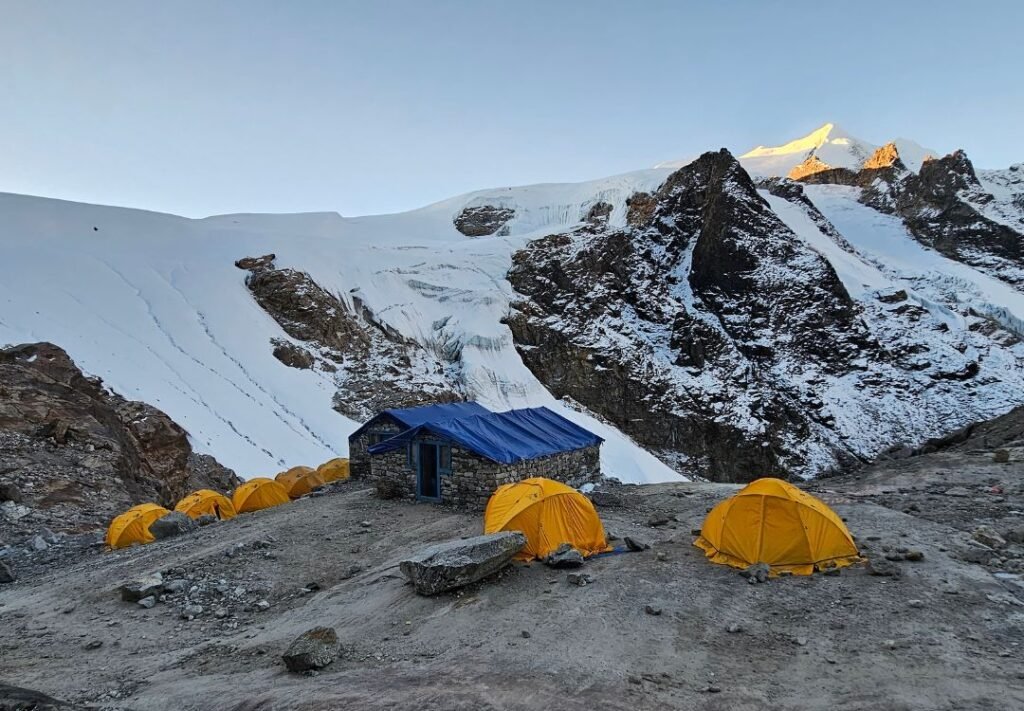
Mera Peak Base Camp — known locally as Khare — sits at 5,045 metres and is the last inhabited point before the glacier. Unlike the permanent teahouse settlements lower on the trail, Khare is a seasonal cluster of simple lodges and tented camp areas perched on the moraine above the Hinku Valley. The views from here — of Mera Peak itself, Island Peak, and the distant Everest massif — are extraordinary.
Your acclimatization day at Khare is one of the most important days of the entire expedition. In the morning, you hike up toward the glacier and back to practice altitude exposure. In the afternoon, your Sherpa climbing guide conducts the technical training session: crampon fitting and walking technique, ice axe use and self-arrest, rope movement, and a full briefing on the summit route. Do not underestimate this day — it is where you will feel the altitude most sharply and where your body will do much of its physiological adaptation work.
Mera Peak Climb Itinerary: How Many Days?
The Mera Peak climb itinerary typically ranges from 14 to 21 days from Kathmandu, depending on experience level and how much buffer you want for weather and acclimatisation. Here is how the options break down:
| Duration | Best For |
|---|---|
| 14–15 days | Experienced trekkers with strong prior altitude exposure |
| 17–18 days | Most climbers — our recommended standard |
| 20–21 days | Extra acclimatisation margin, weather buffer, or combined itineraries |
Our recommended 17 to 18-day itinerary from Kathmandu includes: fly to Lukla, 6 to 7 days of trekking through the Hinku Valley to Khare, two nights at Khare for acclimatisation and skills training, summit push via High Camp (5,780 m) to the summit (6,476 m), descent, and return to Lukla. One contingency day for weather is always built in.
At We Ramblers, we do not compress Mera Peak itineraries below 17 days. The mountain decides the schedule — not the calendar.
Mera Peak Climb Package: What’s Included and What It Costs
A fully guided Mera Peak climb package from a reputable agency typically includes all mandatory permits, a licensed Sherpa climbing guide, porters, teahouse and tented accommodation along the route, most meals, and equipment support at Base Camp. Budget approximately USD 2,800 to USD 3,200 per person for a well-run, safety-focused package.
Three permits are required: the NMA Climbing Permit (USD 250 in spring, USD 125 in autumn), the Makalu Barun National Park Entry Permit, and a Local Area Permit. International flights, personal gear, and travel insurance — which must cover helicopter evacuation to at least 6,500 m — are additional and non-negotiable.
Best Season to Climb Mera Peak
Autumn (October–November) is the prime season — post-monsoon skies are crystal clear, glacier conditions are stable, and temperatures on the summit are at their most manageable. October is widely considered the single best month of the year. Spring (March–May) is an equally popular and beautiful season, with rhododendron forests in full bloom through the lower valleys.
Avoid the monsoon (June–August). Winter climbing (December–January) is possible but carries significantly elevated risk from cold, wind, and reduced summit success rates — not recommended unless you have specific cold-weather experience.
Is Mera Peak Right for You?
How fit do you need to be to climb Mera Peak? Fit enough to sustain long daily efforts over consecutive days at altitude, strong enough in the legs to handle relentless moraine and steep snow slopes, and mentally resilient enough to push through a pre-dawn summit attempt when your body is already tired. That is the real answer.
If that describes you — or the person you are committed to becoming over the next 12 weeks of training — Mera Peak is absolutely within your reach. The summit panorama across five 8,000-metre giants is one of the great rewards in all of Himalayan trekking, and the route through the Hinku Valley is a magnificent journey in its own right.
At We Ramblers, we offer fully guided Mera Peak climb packages with small groups, experienced Sherpa climbing guides, and itineraries built around your safety and summit success.
Contact the We Ramblers team to start planning your Mera Peak climb.
Frequently Asked Questions: How Fit Do You Need to Be to Climb Mera Peak?
1. How fit do you need to be to climb Mera Peak if you have never trekked before?
If you have never trekked or spent time at altitude before, Mera Peak is not the right first step — and we say that with genuine care for your safety and enjoyment. The combination of 6 to 8-hour daily walking stages, five consecutive days above 5,000 metres, and a 3 AM summit push in freezing temperatures is simply too demanding for someone with no acclimatisation experience. Our strong recommendation is to first complete a serious high-altitude trek — the Everest Base Camp trek or the Manaslu Circuit are ideal — to understand how your body responds to altitude and sustained effort. Then come back to Mera Peak with the experience it deserves.
2. Do I need any prior climbing experience for Mera Peak?
You do not need a mountaineering CV, but you do need to be comfortable learning and practising basic technical skills. Your Sherpa climbing guide will conduct a full training session at Khare (Mera Peak Base Camp) covering crampon use, ice axe technique, rope movement on a glacier, and jumar ascender use on the fixed lines near the summit. Arriving with some prior exposure to these skills — even a single mountaineering day course or a winter hillwalking weekend in crampons — is genuinely helpful. Arriving with zero awareness and expecting to learn everything on the day is a risk not worth taking at 5,000 metres.
3. What is the best time of year to attempt the Mera Peak climb?
Autumn (October and November) is the most popular and reliable season, offering stable weather, clear skies, and well-consolidated glacier conditions on the summit route. October is the single best month. Spring (March to May) is equally rewarding, with warmer valley temperatures and rhododendron forests in bloom on the approach. March can bring snowfall at high altitude, so April and May are slightly more reliable for the summit push. Winter (December–January) and monsoon (June–August) are both strongly discouraged — the former due to extreme cold and wind on the summit ridge, the latter due to unstable trail conditions throughout the Hinku Valley.
4. How long does the summit day take on Mera Peak?
Summit day is the longest and most demanding day of the entire expedition. Most climbers depart High Camp (5,780 m) between 2 AM and 3 AM to maximise their weather window and ensure a safe descent before afternoon conditions deteriorate. The ascent from High Camp to the summit (6,476 m) takes approximately 4 to 6 hours depending on fitness, snow conditions, and the pace of the group. The descent back to High Camp takes 2 to 3 hours, and most climbers then continue down to Khare the same day — making summit day a total of 10 to 14 hours on the mountain. A good headlamp, warm layers, and a strong mental game are essential.
5. What gear do I need to climb Mera Peak?
The essential technical gear list includes mountaineering boots (double-layered, 4-season rated), 12-point crampons, an ice axe, a climbing harness, a belay device, a jumar ascender, locking carabiners, and a helmet. For clothing, high-altitude down suit or a combination of mid-layer and insulated jacket, waterproof shell, warm gloves, balaclava, and UV-protective glacier goggles are all necessary. A quality 4-season sleeping bag rated to at least -20°C is required for High Camp. Most reputable Mera Peak climb packages — including those offered by We Ramblers — include crampons, ice axes, and harness rental in the package cost, reducing the amount of technical gear you need to purchase or bring from home.
6. Can I climb Mera Peak without a guide?
No. Mera Peak is a restricted climbing peak under the Nepal Mountaineering Association (NMA), and a licensed Sirdar or climbing Sherpa guide is a mandatory requirement for the permit. Independent solo climbing is not permitted. Beyond the legal requirement, the practical case for a skilled, experienced Sherpa guide on a 6,476-metre glacier peak is overwhelming — crevasse navigation, weather assessment, technical rope management, high-altitude first aid, and summit-or-turn-around decision making are all situations where their experience is genuinely life-saving. At We Ramblers, our climbing Sherpa guides are among the most experienced on this specific route.
7. What is the difference between Mera Peak North, Central, and South?
Mera Peak has three distinct summits: Mera Central (6,476 m) — the highest and the standard summit target for climbing packages; Mera North (6,476 m) — considered equally high but rarely attempted separately; and Mera South (6,065 m) — the lowest of the three and occasionally traversed on the descent. The vast majority of guided Mera Peak climb itineraries, including all We Ramblers departures, target Mera Central as the primary summit objective. When trekking agencies or permit documents refer to “Mera Peak,” they are almost universally referring to the Central summit.