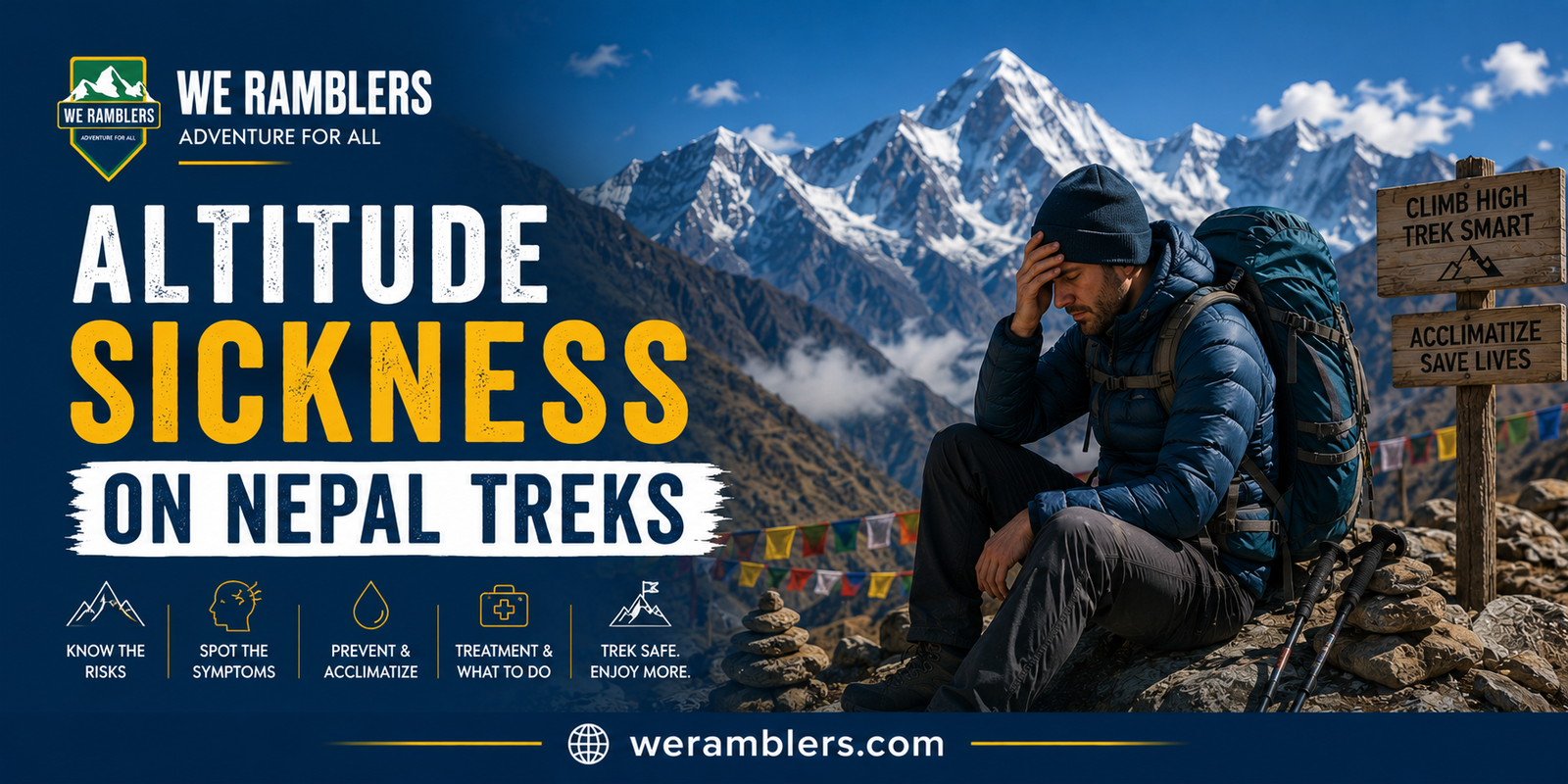
Altitude sickness is the single greatest safety risk on Nepal’s high-altitude trekking routes. It affects trekkers regardless of age, fitness level, or prior experience at altitude. A seasoned marathon runner can develop severe altitude sickness while an unfit first-timer acclimatises perfectly. Understanding the condition before you leave for Nepal is not optional. It is part of responsible trek preparation.
This guide covers the symptoms of altitude sickness on Nepal treks, how to prevent it, the medications available, and most critically, when you must descend.
What Is Altitude Sickness?
Altitude sickness, medically known as Acute Mountain Sickness (AMS), occurs when the body does not acclimatise fast enough to reduced oxygen levels at elevation. Above 2,500 metres, the amount of oxygen in each breath decreases significantly. Your body responds by breathing faster, producing more red blood cells, and adjusting blood flow, but these processes take time.
When you gain altitude faster than your body can adapt, fluid can accumulate in the lungs or brain. This progression from mild AMS to High Altitude Pulmonary Oedema (HAPE) or High Altitude Cerebral Oedema (HACE) can be fatal if not treated promptly.
On Nepal’s most popular trekking routes, you are regularly sleeping above 3,500 metres. Everest Base Camp sits at 5,364 metres. Thorong La Pass on the Annapurna Circuit reaches 5,416 metres. Altitude sickness is not a theoretical risk on these routes. It is a constant one.
Altitude Sickness Symptoms to Know
Mild AMS Symptoms
Mild acute mountain sickness typically appears within six to twelve hours of arriving at a new elevation. Symptoms include:
- Headache, often described as a tight pressure across the forehead
- Fatigue disproportionate to the physical effort
- Loss of appetite or mild nausea
- Difficulty sleeping
- Dizziness when standing
These symptoms alone are not cause for immediate alarm, but they are your body’s clear signal to stop ascending. Do not gain more altitude until every mild symptom has completely resolved.
Moderate AMS Symptoms
Moderate altitude sickness represents a serious escalation. Symptoms include:
- Persistent, worsening headache that does not respond to ibuprofen or paracetamol
- Vomiting rather than nausea
- Severe fatigue and weakness
- Loss of coordination or balance
- Confusion or disorientation
At this stage, descending is necessary. Do not sleep at the same altitude. Descend a minimum of 300 to 500 metres immediately, even if it is the middle of the night.
HAPE: High Altitude Pulmonary Oedema
HAPE involves fluid accumulation in the lungs. It is one of the leading causes of altitude-related death and can develop rapidly. Symptoms include:
- Breathlessness at rest, not just during exertion
- A dry cough that progresses to producing pink or frothy mucus
- Blue-tinged lips or fingernails (cyanosis)
- Gurgling sounds when breathing
HAPE requires immediate descent of at least 1,000 metres and evacuation to a hospital. This is a medical emergency.
HACE: High Altitude Cerebral Oedema
HACE involves swelling of the brain and is the most severe altitude-related illness. Symptoms include:
- Extreme confusion and disorientation
- Loss of coordination. The ataxia test works like this: ask the person to walk a straight line heel-to-toe. If they cannot, HACE is likely.
- Hallucinations
- Loss of consciousness
HACE requires immediate descent and emergency evacuation. Every minute counts.
How to Prevent Altitude Sickness on Nepal Treks
Ascend Slowly
The most effective altitude sickness prevention strategy is a slow, gradual ascent. The general rule is: above 3,000 metres, do not increase your sleeping altitude by more than 300 to 500 metres per day. Itineraries that include acclimatisation days, like the rest day in Namche Bazaar on the EBC trek, are structured this way for a reason. Do not skip them regardless of how good you feel.
Climb High, Sleep Low
On acclimatisation days, many trekkers hike to a higher elevation during the day and return to a lower sleeping altitude. This strategy stimulates the body’s adaptive response without the stress of sleeping at extreme altitude. The hike to Everest View Hotel from Namche is a classic example.
Stay Hydrated
Dehydration worsens the symptoms of altitude sickness. Drink three to four litres of water per day on a Nepal trek. Avoid alcohol, particularly in the first few days at altitude, since it suppresses respiration and accelerates dehydration.
Consider Diamox (Acetazolamide)
Diamox is a prescription medication that accelerates acclimatisation by stimulating the kidneys to excrete bicarbonate, which causes the blood to become more acidic and increases the rate of breathing. A typical preventive dose is 125mg twice daily, starting one day before ascending above 3,000 metres.
Side effects include increased urination, tingling in the fingers, and altered taste of carbonated drinks. Consult your doctor before taking Diamox since it is not suitable for people with sulfa drug allergies.
Do Not Fly Directly to High Altitude
If your trek begins in a high-altitude location such as flying into Lukla at 2,840 metres, spend a minimum of two nights in Kathmandu (1,400 metres) before flying. Do not fly from sea level directly to Lukla and begin trekking the same day.
The Golden Rules: When to Descend
These rules apply without exception.
Never ascend with any symptom of AMS. If you have a headache, fatigue, or nausea, stay where you are until the symptoms fully clear.
Descend immediately if symptoms worsen. A worsening headache despite rest and medication is a clear sign that your body is not coping.
Descend immediately if you show signs of HAPE or HACE. Do not wait until morning. Do not wait to feel worse. Descend right now, even at night.
Do not let a guide, other trekkers, or your own stubbornness delay descent. Summit pressure and sunk cost thinking kill people at altitude.
A descent of 300 to 500 metres relieves mild to moderate AMS within hours. A Gamow bag (portable hyperbaric chamber) can provide temporary relief if evacuation is delayed. Many well-equipped teahouses and rescue posts on popular routes carry oxygen and Gamow bags.
Altitude Sickness and Trek Insurance
Travel insurance that covers high-altitude trekking and emergency helicopter evacuation is not optional in Nepal. Helicopter evacuations from the Everest region cost between USD 3,000 and USD 6,000. Without insurance, many trekkers face impossible financial decisions in genuine medical emergencies.
Before your trek, confirm your policy explicitly covers high-altitude trekking above 5,000 metres. Many standard travel insurance policies cap altitude coverage at 4,000 or 4,500 metres.
Altitude sickness does not discriminate. Respect it, prepare for it, and know that the mountain will still be there next year.
Trek Safely in Nepal With We Ramblers
Understanding altitude sickness is critical. Trekking with an experienced, safety-conscious team is equally important. We Ramblers is a registered Nepal trekking company with offices in Kathmandu and Bengaluru, built around the belief that every trekker deserves a guide who genuinely knows the mountains they are walking in.
Every We Ramblers guide is trained in altitude sickness recognition, first aid, and emergency response. Itineraries are designed with acclimatisation built in, not squeezed out to save a day. The team knows which teahouses carry oxygen, where the nearest rescue posts are, and how to get a helicopter evacuation moving fast if the situation demands it.
If you want to trek Nepal with a team that takes your safety as seriously as you do, visit weramblers.com to explore available treks or speak directly with the team about a route that suits your fitness level and timeline.