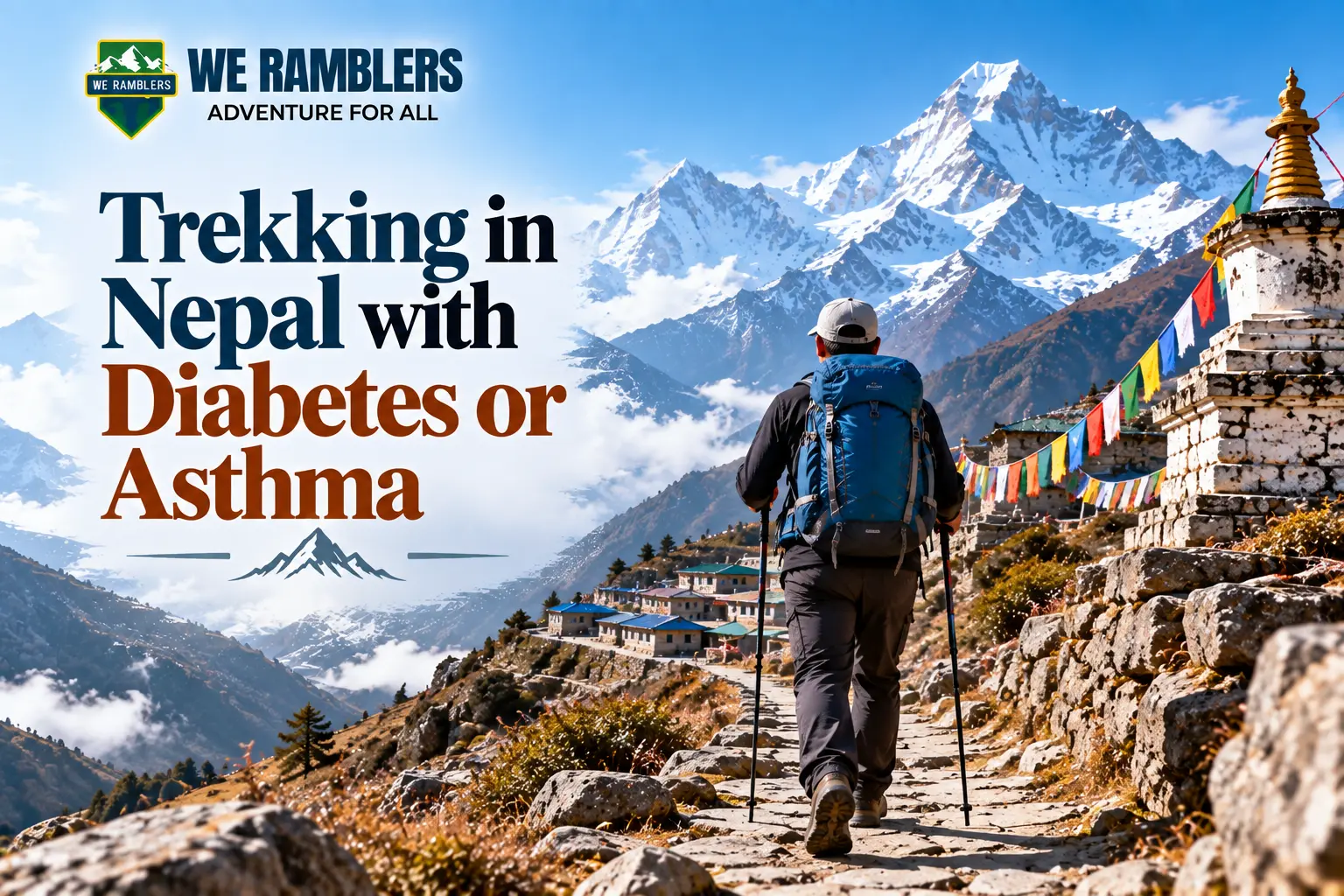
Can you really trek in Nepal if you live with diabetes or asthma, or does the altitude make the trip too risky? For many travellers, the answer is not a simple yes or no. Trekking in Nepal with Diabetes or Asthma can be possible when the condition is well controlled, the route matches the traveller’s health and fitness, and the trek is planned with a doctor and a responsible trekking operator. Altitude changes the way the body handles exercise, breathing, hydration and, in the case of diabetes, blood glucose. Cold, dry air can also trigger breathing symptoms in some people with asthma.
This guide explains what to consider before booking, how altitude can affect diabetes and asthma, which Nepal trekking routes may be more manageable, what a trek can cost, and which medical and travel documents to carry. It also covers medication planning, TIMS and trekking registration, acclimatization, warning signs and what to do if symptoms develop on the trail.
Quick Answer
Trekking with Diabetes
- Blood Sugar Shifts: Long walking days can affect blood glucose, so check your levels regularly and keep fast-acting glucose within easy reach.
- Altitude & Meters: High altitude can affect how some glucose meters work. If you are trekking in Nepal with diabetes, discuss monitoring at altitude with your healthcare team and follow the testing plan they recommend.
- Supplies & Storage: Carry enough diabetes supplies for the full trip, plus extra for delays. Keep insulin and other temperature-sensitive supplies protected from extreme cold and heat, and never let insulin freeze.
- Dietary Adjustments: Meals on trekking routes may be different from what you normally eat and may contain plenty of rice, noodles or potatoes. Plan meal timing and medication around your usual diabetes management plan rather than making changes on your own.
Trekking with Asthma
- Air Quality: Kathmandu can have poor air quality, while mountain routes bring different conditions such as cold and dry air. Know your personal asthma triggers before starting the trek.
- Cold & Exertion Triggers: Cold air and strenuous uphill walking can trigger asthma symptoms in some people. Keep your prescribed reliever medicine accessible rather than buried inside your main backpack.
- Medication Protocol: Continue your prescribed asthma treatment according to your doctor’s instructions. Carry enough medicine for the entire trek, including extra supplies if your doctor recommends them.
- Route Selection: If your asthma is severe, poorly controlled or easily triggered by exercise or cold air, discuss the route with your doctor before booking. A lower-altitude Nepal trekking route may be more appropriate than a route involving prolonged exposure to very high altitude.
Essential Safety Tips
- Medical Clearance: Speak with your doctor or specialist before a high-altitude trek, especially if your diabetes or asthma is not well controlled, your medication has changed recently, or you have another medical condition that may affect strenuous activity.
- Brief Your Team: Tell your guide and trekking companions about your condition, the medicines you carry and what they should do if you become unwell. Keep important medical information and emergency instructions easy to access.
Can You Go Trekking in Nepal with Diabetes or Asthma?
When Trekking May Be Possible
There is no blanket rule that prevents every person with diabetes or asthma from trekking in Nepal. People with well-controlled conditions may be able to take part in strenuous travel, but the route and the way the condition is managed matter. A sensible starting point is a trek where the daily walking schedule, maximum sleeping altitude and access to help are clear before departure.
- Your diabetes or asthma is reasonably well controlled and you know your usual warning signs.
- You have enough prescribed medication and backup supplies for the full trip, with extra allowance for delays.
- You have discussed the planned maximum altitude and level of exertion with your doctor when medical advice is needed.
- The itinerary gives you time to acclimatize rather than pushing quickly to a high sleeping altitude.
- Your guide or trekking operator knows about your condition and understands what to do if you become unwell.
- You have suitable travel insurance and understand whether high-altitude trekking and emergency evacuation are covered.
For a traveller researching trekking in Nepal with diabetes or asthma, route choice should come before excitement about a particular summit or viewpoint. A shorter trek with lower sleeping altitudes may be a better starting point than choosing a famous high route simply because it is popular.
When You Should Get Medical Clearance Before Trekking
A doctor’s assessment becomes especially useful when your condition is not stable or when the trek places you well above the altitude you normally experience. The CDC recommends medical discussion before high-elevation travel for people with pre-existing conditions, including people with heart or lung disease and people with diabetes.
- Your symptoms are poorly controlled or have become more frequent.
- Your diabetes treatment or asthma treatment has changed recently.
- You have had a serious episode of hypoglycemia, hyperglycemia, an asthma attack or altitude illness.
- You have another significant heart, lung or metabolic condition that could affect strenuous activity or high altitude.
- You are planning a route with several nights at high altitude or limited access to medical care.
- You are unsure whether your current medication plan will work with long walking days, cold conditions or irregular meal times.
Medical clearance should relate to the actual trip. A doctor should know the route, expected maximum altitude, number of trekking days and level of physical effort rather than simply being asked whether you are ‘fit for travel’ in general.
When a Nepal Trek May Need to Be Postponed
A trek may need to wait if you are currently unwell, your asthma is not controlled, your blood glucose is repeatedly outside the range discussed with your healthcare team, or you have not recovered from a recent serious illness. The same applies if you cannot reliably carry, store or use the medication you depend on. There is little value in starting a remote trek while hoping a health problem will settle on its own.
The aim is not to create a long list of people who ‘cannot trek’. It is to avoid starting a high-altitude journey when the health plan is not ready for the conditions on the ground.
How High Altitude Affects Diabetes and Asthma
What Changes at High Altitude?
As altitude increases, atmospheric pressure falls. The percentage of oxygen in the air remains about the same, but each breath delivers fewer oxygen molecules than it does at sea level. Your body responds by breathing more and working harder to maintain oxygen delivery. If you are dehydrated or exhausted, it can become harder to judge what is causing your symptoms.
For a trekker, the change is not only about oxygen. Long walking days increase energy use. Cold and dry conditions can increase respiratory irritation. Dehydration can become easier when you walk for hours and do not drink regularly. Appetite may also change, which matters when meals and medication need to stay reasonably predictable.
Nepal has routes at very different elevations. The Nepal Tourism Board describes trekking routes that range from lower mountain walks to sections above 5,000 meters. That wide range means different Nepal treks can involve very different levels of physical and medical demand.
Why Altitude Sickness Can Be Confused with Other Symptoms
Acute mountain sickness, or AMS, can cause headache, fatigue, dizziness, nausea and reduced appetite. More serious altitude illness can cause confusion, poor coordination, severe breathlessness or other symptoms that need urgent action. The problem for someone with diabetes or asthma is that some of these symptoms can overlap with the person’s usual condition.
For example, sweating, weakness, shakiness and confusion may occur with low blood glucose. Breathlessness and chest tightness may be part of an asthma flare, but breathlessness at altitude can have other causes. Vomiting may be linked to altitude illness, illness on the trail or difficulty maintaining normal food and fluid intake.
Do not try to diagnose a serious problem from one symptom alone. Use the person’s established diabetes or asthma action plan, tell the guide early and take worsening symptoms seriously. The CDC advises people with altitude illness not to continue to higher elevations while symptomatic and notes that worsening symptoms at rest are a reason to move to a lower elevation.
Trekking in Nepal with Diabetes
How Trekking and Altitude Can Affect Blood Sugar
A trek changes the normal diabetes routine. You may walk for several hours, eat at different times, eat foods you do not normally choose and sleep at a different altitude every night. That combination can make blood-glucose management less predictable.
The CDC notes that delayed meals, unfamiliar foods and changes in activity can affect blood sugar while travelling. It also recommends checking blood sugar regularly and carrying diabetes supplies where they are easy to reach. At high altitude, the issue becomes more complicated because not all glucose meters perform identically at altitude, according to the CDC Yellow Book.
- Plan how you will monitor glucose during long walking days.
- Keep fast-acting glucose within easy reach rather than buried inside your main pack.
- Avoid skipping meals simply because you are not hungry after a hard climb.
- Carry enough food for delays between teahouses or meal stops.
- Discuss medication adjustments with your diabetes team before the trek rather than changing doses on your own.
- Keep a record of your medication, monitoring plan and emergency instructions.
Managing Insulin and Diabetes Medication at Altitude
Medication storage deserves more attention than many first-time trekkers expect. Insulin should not be allowed to freeze. Diabetes UK advises keeping insulin at a suitable temperature in cold climates and warns that frozen insulin cannot be used.
At the same time, do not expose insulin or monitoring equipment to excessive heat or direct sunlight. The CDC also advises travellers not to put insulin directly on ice and not to store it in checked luggage when flying because of temperature risks.
- Carry medication and essential diabetes equipment in your hand luggage during flights.
- Use an appropriate insulated pouch when needed, but make sure insulin does not touch frozen ice packs.
- Keep essential medication accessible during the trek.
- Carry backup supplies in case of delays, lost luggage or an extended itinerary.
- Split important supplies between two bags if practical.
- Carry prescriptions and a medical summary that explains your medication and equipment.
Do not copy a generic insulin schedule from a trekking article. Your medication needs depend on your treatment, food intake, activity and glucose readings. The right adjustment should come from the clinician who manages your diabetes.
Diabetes-Friendly Food and Hydration on the Trail
Teahouse meals are practical, but the food available on a trek may not resemble your usual meal plan. Rice, noodles, potatoes, bread and other carbohydrate-rich foods are common. That does not mean you need to avoid them. It means you should know what you are likely to eat and plan medication and monitoring around your normal medical advice.
Long walking days also make regular eating more important. Keep suitable snacks with you so that a delayed lunch does not become a medical problem. Water should remain part of the plan throughout the day. If you use electrolyte products, choose them according to your own medical advice rather than assuming every sports drink is suitable for you.
A useful rule for trekking in Nepal with diabetes is to avoid leaving food and medication planning until you are already on the trail. Know where your next meal is expected, what backup snack you carry and what you will do if the day’s walk takes longer than planned.
Diabetes Warning Signs That Mean You Should Stop and Seek Help
A trekker should not try to ‘push through’ a serious diabetes problem. Stop walking and tell your guide if you develop severe or persistent symptoms.
- Severe or repeated hypoglycemia that does not respond to the person’s established treatment plan.
- Confusion, inability to self-treat or a change in normal behaviour.
- Persistent vomiting that prevents you from keeping fluids or food down.
- Significant glucose abnormalities that remain uncontrolled according to your medical plan.
- Ketones where your diabetes care plan says they should be checked.
- Severe weakness or other symptoms that make it unsafe to continue walking.
If symptoms suggest a serious medical problem or altitude illness, the next step may be descent and medical assessment rather than simply another snack or a longer rest. The guide should know this plan before the trek begins.
Trekking in Nepal with Asthma
How High Altitude and Cold Air Affect Asthma
Asthma affects people differently, but cold air, exercise, respiratory infections, smoke and pollution can trigger symptoms in some people. The NHS lists exercise, cold air, air pollution, dust and infections among possible asthma triggers.
A mountain trek adds another factor: you breathe more as the climb becomes harder and the air gets thinner. Rapid breathing of cold, dry air can irritate the airways, particularly for people who already notice symptoms during outdoor exercise. That does not mean everyone with asthma will struggle at altitude. It means you should know your own triggers and follow the treatment plan given by your clinician.
Common Asthma Triggers on Nepal Trekking Routes
- Cold early mornings, especially at higher sleeping elevations.
- Dry air and increased breathing during steep climbs.
- Dust on busy or dry sections of trail.
- Hard uphill exertion when the body is not accustomed to the pace.
- Smoke or strong fumes where they are present.
- Respiratory infections picked up during travel.
- Urban pollution in Kathmandu if pollution is one of your known triggers.
The practical response is not to avoid every possible trigger. It is to know which ones affect you, keep your prescribed medication accessible and avoid starting the trek with poorly controlled asthma. The American Lung Association also notes that triggers vary from person to person and can include exercise, infections and irritants.
What Asthma Medication Should You Carry?
Carry the medication already prescribed for your asthma and follow your personal asthma action plan. A traveller may need a reliever inhaler, a preventer/controller medicine, a spacer if normally used, and backup medication where the clinician has advised it.
- Keep your reliever inhaler where you can reach it quickly.
- Carry your regular preventer/controller medicine and do not stop it simply because you are travelling.
- Use a spacer if it forms part of your usual treatment.
- Carry a backup supply if your clinician has advised one.
- Keep a written record of your medicines and emergency instructions.
- Tell the guide what an asthma flare looks like for you and what action your plan requires.
This is why a trekking medicine list should be personal rather than copied from a general packing article. Medication names, doses and emergency treatment depend on the individual.
Asthma, AMS or Khumbu Cough: How Can Symptoms Overlap?
Breathlessness on a mountain is not automatically an asthma attack. A person may breathe harder because of the climb, react to cold air, develop an asthma flare, or develop an altitude-related problem. Cough can also have several causes.
Look at the whole picture: Is there wheezing? Chest tightness? A known trigger? A change from the person’s normal exercise response? Are there headaches, nausea, confusion or poor coordination as well? Is the person getting worse despite rest and their established asthma treatment?
If you are unsure, tell the guide and seek medical advice. Do not assume that every breathing problem should be treated as asthma or that every cough is simply a ‘Khumbu cough’.
Which Nepal Treks May Suit Travellers with Diabetes or Asthma?
There is no single best route for every traveller. The most suitable trek depends on your health, fitness, previous altitude exposure, medication needs and comfort with remote terrain.
The route comparison below is not a ranking. It is a way to look at altitude and trek style before discussing a route with a doctor or operator. Maximum altitude and duration can vary with the exact itinerary.
Ghorepani Poon Hill Trek
Poon Hill reaches about 3,210 metres. Nepal Tourism Board material lists the Ghorepani–Poon Hill route at roughly 4–7 days and describes it as a moderate trek.
For diabetes, the lower maximum altitude can make the route a useful option to discuss when compared with higher Himalayan itineraries, but long uphill and downhill days still require planning for food, glucose checks and medication. For asthma, cold mornings and uphill exertion remain relevant even though the route does not reach the altitude of Everest Base Camp.
Langtang Valley Trek
Nepal Tourism Board lists the Langtang Valley Trek among Nepal’s major trekking routes and gives a typical duration of about 8–12 days in its country travel material. The valley reaches well above 3,000 metres, with Kyanjin Gompa commonly used as the upper destination on standard itineraries.
The route has meaningful altitude exposure, so acclimatization and symptom monitoring matter. A traveller with diabetes should plan for several days of walking and changing meal patterns. A traveller with asthma should consider cold, dry air and the effort required on higher sections.
Mardi Himal Trek
Mardi Himal Base Camp is around 4,500 metres according to Nepal Tourism Board destination information. The route is shorter than some classic long treks but reaches a high elevation, so the word ‘short’ should not be confused with ‘low altitude’.
For diabetes, higher altitude and sustained walking make glucose monitoring, hydration and medication planning important. For asthma, cold air, exertion and breathlessness at altitude need careful attention. This route should be discussed with a doctor if the condition is not firmly controlled.
Annapurna Base Camp Trek
Nepal Tourism Board material places Annapurna Base Camp at about 4,130 metres and describes standard itineraries in the range of roughly 8–12 days.
The route combines substantial walking with a meaningful rise in altitude. Diabetes management needs to account for activity, food and hydration over several days. Asthma management needs to account for cold air, exertion and symptoms that could overlap with altitude illness.
Everest Base Camp Trek
Nepal Tourism Board describes the Everest Base Camp trek as a roughly two-week journey from Lukla and specifically notes that trekkers should spend time acclimatizing around Namche rather than rushing upward. The route reaches around 5,364 metres at Everest Base Camp.
This is a high-altitude itinerary, not simply a longer walk. For diabetes, the combination of high altitude, sustained exercise, cold and changing meals requires a detailed medical plan. For asthma, the higher elevation and cold, dry air make symptom recognition especially important. A person considering this route should discuss the actual itinerary and maximum sleeping altitude with their doctor.
Route Comparison Table
| Trek | Maximum altitude | Typical duration | Altitude exposure | Diabetes considerations | Asthma considerations |
| Ghorepani Poon Hill | 3,210 m | 4–7 days | Moderate | Plan food, glucose checks and medication for long walking days | Cold mornings and uphill exertion can trigger symptoms |
| Langtang Valley | Above 3,000 m; Kyanjin area higher | 8–12 days | Moderate to high | Longer exposure means careful monitoring and supply planning | Cold, dry air and exertion need attention |
| Mardi Himal | 4,500 m | Short itinerary; varies | High for its duration | Altitude plus activity can complicate glucose management | Higher altitude, cold air and exertion can overlap with breathing symptoms |
| Annapurna Base Camp | 4,130 m | 8–12 days | High | Several days of exercise and changing meals | Cold air, exertion and altitude symptoms can overlap |
| Everest Base Camp | About 5,364 m | About 2 weeks | Very high | Detailed plan for glucose, food, medication and altitude | High altitude and cold, dry air require careful symptom monitoring |
If you are comparing routes for Trekking in Nepal with Diabetes or Asthma, look beyond the final altitude number. Ask how quickly the itinerary climbs, where you sleep each night, how long the walking days are, what food is available, how remote the route becomes and what the emergency plan looks like.
How Much Does Trekking in Nepal with Diabetes or Asthma Cost?
There is no single price for trekking in Nepal with diabetes or asthma because the final amount depends on the route, number of days, group size, guide and porter arrangements, permits, accommodation, transport, insurance and personal medical needs.
A good budget starts with the normal trek cost and then adds the expenses that may arise because of your health plan. Do not use a generic internet package price as your final budget without checking what it includes.
What Is the Typical Cost of a Nepal Trek?
The cost of a Nepal trek depends on the route, number of days, group size, accommodation, guide and porter arrangements, permits and transport. Travellers with diabetes or asthma should also allow for medical consultations, additional medication, insurance and any extra support they may need.
| Cost factor | What it may include |
| Trek package | Accommodation, meals, guide and other services included by the operator |
| Permits and TIMS | Route permits, protected-area fees and TIMS where applicable |
| Transport | Transfers between Kathmandu, Pokhara or the trailhead, depending on the route |
| Guide or porter | Guide services and porter support, if not already included |
| Medical preparation | Doctor consultation, medical certificate or required paperwork |
| Medication and supplies | Prescription medicines, glucose-monitoring supplies, inhalers and backup supplies |
| Travel insurance | Cover for pre-existing conditions, trekking and emergency evacuation, subject to the policy |
| Unexpected expenses | Extra accommodation, transport or additional days caused by illness, weather or route changes |
For travellers comparing the cost of trekking in Nepal with diabetes or asthma, the package price is only one part of the budget. Ask the trekking operator for an itemised quote and check exactly what is included before booking. Medical and insurance costs can vary from person to person, so they are better treated as separate expenses rather than added to a standard trek price.
What Does the Trek Cost Include?
- Accommodation on the trekking route.
- Meals included in the operator’s package.
- Guide and, if booked, porter services.
- Transport to and from the trailhead.
- Route permits and protected-area entry fees where applicable.
- TIMS charges where applicable.
- Operator and agency fees.
Government charges can change, so check the current Nepal Tourism Board information before paying. As of October 2026, the current NTB TIMS page states NPR 1,000 for SAARC applicants and NPR 2,000 for other applicants under its current online TIMS process. It also lists specific routes where a licensed guide and agency-issued TIMS are required.
What Extra Costs Should You Budget For?
- A pre-trek medical consultation.
- Extra acclimatization days if your doctor or guide recommends a slower itinerary.
- Additional prescribed medication or monitoring supplies.
- A suitable medical or travel insurance policy.
- Emergency evacuation cover if included by your insurer.
- Extra porter support if carrying medical equipment or additional supplies.
- Unexpected transport or accommodation if weather, illness or route conditions change the plan.
If a route enters a restricted area, a special trekking permit may also apply. Nepal Tourism Board states that restricted areas require a trekking permit from the Department of Immigration and that the permit must be carried while trekking.
Can Medical Requirements Increase the Cost of a Nepal Trek?
They can. A traveller who needs extra medication, additional luggage, a longer acclimatization plan, a porter for supplies or a more comprehensive insurance policy may spend more than another trekker on the same route. That does not mean diabetes or asthma automatically makes a trek expensive. The extra cost depends on what your personal plan requires.
When comparing the cost of trekking in Nepal with diabetes or asthma, ask for an itemised quote. Check whether permits, TIMS, guide services, meals, accommodation, transport, insurance and emergency arrangements are included. That gives you a more useful figure than a headline package price.
Do You Need a Trekking Medical Certificate?
A trekking medical certificate is not one universal document that every trekker in Nepal must carry for every route. Requirements can vary by operator, itinerary, insurer and individual circumstances. Do not assume that a certificate is compulsory for every Nepal trek, and do not assume that one certificate will satisfy every organisation.
What Is a Medical Certificate for Trekking?
A medical certificate for trekking generally means a document from a qualified medical professional stating that the person has been assessed for the planned activity or travel. What it says depends on the doctor, the operator and the purpose of the document
For someone planning high-altitude travel with diabetes or asthma, the useful document is one that gives enough relevant information for the trip. Depending on the situation, that may include the condition, current medication, important precautions and the altitude or physical activity being considered.
When Might a Trekking Medical Certificate Be Required?
- A trekking company may request one because of the route or the traveller’s medical history.
- An insurer may ask for medical information or evidence related to pre-existing conditions.
- A doctor may recommend written clearance when the planned altitude or exertion creates a significant concern.
- An individual traveller may want a medical letter for carrying prescription medicines or equipment while travelling.
Ask the operator exactly what document they need before visiting a doctor. If they have a specific form, take that form to the appointment. It is better to have the doctor complete the correct document than to pay for a general letter that does not answer the operator’s questions.
Trekking Medical Form: What Does It Include?
A trekking medical form usually collects health information so the trekking operator can understand relevant risks and know what to do if a problem develops. It is not necessarily the same thing as a doctor’s certificate.
What Information Is Commonly Asked on a Trekking Medical Form?
- Existing medical conditions.
- Current medication and dosage information.
- Known allergies.
- Relevant medical history.
- Emergency contact details.
- Health or fitness information requested by the operator.
- Doctor’s certification where the operator specifically requires it.
Medical Form vs Medical Certificate: What’s the Difference?
| Medical form | Medical certificate |
| Collects health and fitness information | Provides a doctor’s written assessment or clearance |
| May include self-declared information | Issued by a medical professional |
| Often created by an operator | Usually prepared or signed by a clinician |
| Requirement depends on the operator or trip | Requirement also depends on the operator, insurer or individual circumstances |
If your operator gives you a trekking medical form, complete it accurately. Do not leave out diabetes, asthma or medication because you are worried it may affect the booking. The purpose of the information is to help the team prepare for your actual needs.
What Should Your Trekking Medicine List Include?
A useful trekking medicine list starts with your regular prescription medicines and monitoring supplies. It should not be a random list of drugs copied from another trekker.
Diabetes Essentials
- Prescribed diabetes medication or insulin.
- Blood-glucose monitoring equipment or continuous glucose monitoring supplies used by the traveller.
- Fast-acting glucose for treating low blood sugar according to the person’s plan.
- Backup medication and supplies.
- Prescription and medical summary.
- Emergency supplies prescribed by the person’s clinician.
Asthma Essentials
- Prescribed reliever inhaler.
- Prescribed preventer/controller medicine.
- Spacer if normally used.
- Backup inhaler or other emergency medication where advised by the clinician.
- Written asthma action plan where available.
General Trek Health Supplies
- Basic first-aid supplies.
- ORS or electrolyte products where appropriate for the individual.
- Personal prescribed medicines unrelated to diabetes or asthma.
- Copies of prescriptions.
- Medical identification or an emergency information card.
The exact quantity depends on the length of the trip and your medical plan. Carry enough for the full itinerary plus a reasonable backup for delays. Do not change doses or add prescription medicines simply because a trekking checklist recommends them.
What Trekking Documents Do You Need in Nepal?
Your trekking documents should cover three areas: normal travel documents, route-specific paperwork and medical information. Keep the originals secure and carry accessible copies of the documents you may need during the trek.
Personal Travel Documents
- Passport.
- Nepal visa or entry documentation where applicable.
- Copies of your passport and important travel details.
- Passport photographs if required for a particular process.
Trek-Specific Documents
- Trek booking or itinerary confirmation.
- TIMS information where applicable.
- Protected-area entry permits where required.
- Special trekking permit for restricted areas where applicable.
- Travel insurance policy and emergency assistance details.
Medical Documents for Diabetes or Asthma
- Prescription or medication list.
- Doctor’s letter or medical certificate if required.
- Medical summary for important conditions.
- Emergency contact information.
- Relevant medical records or action plan that the guide may need in an emergency.
Should You Carry Copies of Your Medical Documents on the Trail?
Yes. A paper copy can be useful if a phone battery dies or you cannot access an online file. Keep a digital copy as well. For a traveller with diabetes or asthma, the most useful information is concise: diagnosis, medication, allergies, emergency instructions and a contact number for the treating clinician or family member.
This is one of the simplest parts of Trekking in Nepal with Diabetes or Asthma to prepare. Put the documents together before you leave home instead of trying to find them in Kathmandu the day before the trek.
What Does Trekking Registration Involve in Nepal?
Trekking registration in Nepal is closely linked to route permits and the Trekkers’ Information Management System, or TIMS. Requirements are route-specific and can change, so check the current Nepal Tourism Board information before departure.
What Is TIMS?
TIMS records information about trekkers and their routes. The current Nepal Tourism Board page states that specific protected areas require trekkers to travel with a licensed guide and carry an agency-issued TIMS card. It lists Everest, Langtang, Mardi Himal and several other routes under the revised provisions.
Which Nepal Trekking Routes Require Registration or a TIMS Card?
The current NTB list includes the Everest region, Langtang region and several Annapurna routes, including Mardi Himal and the Poon Hill–ABC route. The exact rule depends on the route. Check the official list rather than relying on an old blog post or a booking page that has not been updated.
The NTB currently states that its online TIMS process charges NPR 1,000 for SAARC applicants and NPR 2,000 for other applicants. These are current figures on the NTB page and should be rechecked at the time of booking because government fees can change.
Who Arranges Trekking Registration?
For routes covered by the current TIMS provisions, a government-registered trekking agency handles the agency-issued TIMS process and guide arrangement. The NTB instructs trekkers to contact a government-registered trekking agency when their chosen route requires a guide and TIMS.
What Information May Be Required for Trek Registration?
The current TIMS process requires the agency to submit trekker, guide and route details. The exact fields can change, so your operator should confirm the information and documents needed for your booking.
For trekking registration, do not use an old fee table as your final source. The Nepal Tourism Board is the better place to confirm the current process and charges.
How to Prepare for a Nepal Trek with Diabetes or Asthma
8–12 Weeks Before the Trek
- Discuss the planned route and maximum altitude with your doctor if your condition or medication makes high-altitude travel a concern.
- Review your current medication and decide how you will carry, store and monitor it.
- Start building the fitness needed for several hours of walking, including uphill and downhill work.
- Review travel insurance and check whether your policy covers pre-existing conditions and high-altitude trekking.
- Ask the trekking operator about the exact itinerary, sleeping altitudes, rest days, guide arrangements and emergency plan.
4–6 Weeks Before the Trek
- Confirm your medication and monitoring supplies.
- Arrange any medical letter or trekking medical certificate the operator or insurer requires.
- Prepare your trekking medical form if the operator uses one.
- Check that glucose meters, sensors, inhalers and other equipment are working and that you have suitable backups.
- Share relevant medical information with the trekking company before the trip.
One Week Before Departure
- Pack prescription medicines and critical supplies in accessible hand luggage for the flight.
- Separate backup supplies so one lost bag does not remove everything you need.
- Check your passport, permits, TIMS information, insurance and medical paperwork.
- Confirm how medication will be stored at cold overnight stops.
- Tell the operator about any change in your health since the booking.
What to Tell Your Trek Operator and Guide
- What condition you have.
- What medication you take and when you normally take it.
- What your early warning signs look like.
- Where you keep your medication and emergency supplies.
- What the guide should do if you develop symptoms.
- Who should be contacted in a medical emergency.
A guide does not replace a doctor. The guide’s role is to help manage the trek, notice changes, communicate quickly and follow the agreed emergency plan.
How to Stay Safe at High Altitude
Follow a Gradual Acclimatization Schedule
Do not treat acclimatization as a day you can remove because you are short on time. The body needs time to adjust to higher altitude. Nepal Tourism Board’s Everest Base Camp guidance specifically recommends spending time around Namche to acclimatize rather than rushing upward.
A route that gains altitude more slowly may be easier to manage than an itinerary that tries to save a day by climbing too quickly. Your operator should explain where the acclimatization stops occur.
Stay Hydrated and Eat Regularly
Carry water and drink regularly. If you have diabetes, keep meals and snacks predictable enough to fit your medical plan. If you have asthma, dehydration and exhaustion can make a hard walking day feel worse even when they are not the cause of the breathing problem.
Keep Your Medication Accessible
Do not place essential medicine at the bottom of a porter bag. Keep the medication you may need during the day with you. Insulin should be protected from freezing, and inhalers should be easy to reach.
Tell Your Guide About Your Medical Condition
Your guide cannot respond to information they do not have. A short conversation at the beginning of the trek can prevent confusion later. Tell them what symptoms matter, what medication you carry and when they should call for help.
Know When to Stop or Descend
Do not treat a worsening symptom as a test of toughness. If you develop symptoms that could indicate significant altitude illness or a serious diabetes or asthma problem, stop and seek help. The Nepal Tourism Board advises high-altitude trekkers to take AMS seriously and points trekkers toward the Himalayan Rescue Association for altitude-related medical assistance.
What to Do If You Develop Symptoms During a Nepal Trek
When to Inform Your Guide
Tell the guide early if you develop unusual breathlessness, repeated dizziness, severe headache, vomiting, confusion, marked weakness, wheezing or symptoms that are different from your normal response to exercise. Waiting until you can no longer walk makes the situation harder to manage.
How to Distinguish a Routine Symptom from a Warning Sign
Some shortness of breath after a steep climb is expected. So is tiredness after a long walking day. What matters is the pattern, severity and whether the symptom improves with rest and the person’s usual treatment.
- AMS may involve headache, dizziness, nausea, fatigue and reduced appetite.
- Low blood glucose may involve sweating, shakiness, weakness, confusion or difficulty thinking clearly.
- Asthma may involve wheezing, cough, chest tightness or shortness of breath.
- Dehydration may cause thirst, weakness, dizziness and reduced physical performance.
- Exhaustion usually improves with rest, food, fluids and a sensible reduction in effort; persistent or worsening symptoms need more attention.
The overlap is exactly why a personal medical plan matters. If you cannot tell what is happening, stop, tell the guide and seek medical advice rather than guessing.
When Descent May Be Necessary
If altitude illness is suspected and symptoms are worsening, descent can be the most important treatment. The CDC states that people with altitude illness should not continue to higher elevations while symptomatic and that worsening symptoms at rest require movement to a lower elevation.
For a trekker with diabetes or asthma, descent decisions should also consider the underlying condition, medication response and access to medical care. A guide and doctor or rescue team may need to decide the safest next step.
When Emergency Evacuation May Be Considered
Emergency evacuation may be considered when a person cannot safely continue, needs medical treatment that is not available on the trail, or develops serious altitude illness or another emergency. The exact process depends on the route, weather, location, operator and insurance.
Before the trek, ask the operator how evacuation requests are handled, who makes the call, how the traveller reaches medical care and what information the insurer needs. The Nepal Tourism Board advises trekkers to contact their local agency for helicopter evacuation and directs people toward the Himalayan Rescue Association for altitude-related medical help.
Why High-Altitude Travel Insurance Matters
Do not buy travel insurance based only on the words ‘medical coverage’. Check the policy wording for pre-existing conditions, trekking altitude, emergency evacuation and the exact activities on your itinerary. Keep the emergency assistance number accessible during the trek.
Frequently Asked Questions About Trekking in Nepal with Diabetes or Asthma
Can you hike Mount Everest with asthma?
People with well-controlled asthma may be able to travel and trek at high altitude, but Everest-area trekking needs more planning than a normal hike. High altitude, cold and dry air, heavy exertion and respiratory infections can all affect breathing. The CDC lists well-controlled asthma as generally presenting no extra altitude risk, but people with poorly controlled symptoms should discuss the trip with a doctor before travelling.
For trekking in Nepal with asthma, carry the medicines prescribed in your asthma action plan and make sure your guide knows what to do if your symptoms worsen.
Do people get altitude sickness in Nepal?
Yes. Altitude sickness can occur in Nepal, particularly when travellers ascend quickly to high sleeping altitudes without enough time to acclimatize. The CDC notes that unacclimatized travellers sleeping at around 2,450 metres or higher can be at risk. Nepal has trekking routes ranging from lower-altitude walks to sections above 5,000 metres, so the level of exposure varies greatly between routes.
Common symptoms of acute mountain sickness include headache, tiredness, nausea, vomiting and loss of appetite. If symptoms worsen while resting, descending to a lower altitude is important.
Is the Annapurna Trek risky?
The level of risk depends on which Annapurna trek you choose, how quickly you gain altitude and your individual health. The Annapurna region includes shorter lower-altitude treks as well as routes that reach much higher elevations. For example, the Annapurna Circuit reaches Thorong La at 5,416 metres, while other routes in the region remain at considerably lower elevations.
For someone with diabetes or asthma, route selection, acclimatization, medication planning and access to medical help should all be considered before booking. There is no single risk level that applies to every Annapurna trek.
Can a normal person climb Annapurna?
It depends on what you mean by “climb Annapurna.” Trekking in the Annapurna region is very different from climbing Annapurna I, which is an 8,091-metre mountain. Nepal Tourism Board lists Annapurna I at 8,091 metres, while the Annapurna region also has trekking routes at much lower elevations.
A person who is reasonably fit may be able to complete an appropriate Annapurna trek, but climbing Annapurna I is a technical high-altitude mountaineering expedition and should not be treated as an ordinary trek. For travellers with diabetes or asthma, the specific route, altitude, fitness level and medical plan matter before making a decision.
Planning a Nepal Trek with Diabetes or Asthma?
Trekking in Nepal with diabetes or asthma is not simply about choosing a famous route and starting the walk. The right trek depends on your health, fitness, medication needs, altitude tolerance and how well you can manage your condition during long days on the trail. A route with gradual acclimatization, suitable walking days and a clear plan for medication, food and emergencies can make the experience much easier to manage.
Before you book, speak with your doctor about the specific itinerary, maximum altitude and physical demands. Check your travel insurance, carry enough medication and keep your medical documents and essential supplies accessible throughout the journey.
If you are ready to explore Nepal trekking routes that match your plans, take a look at We Ramblers to explore the available trekking options. Have questions about the route, itinerary or support you may need? Contact We Ramblers and discuss your plans with the team before you set off.
Disclaimer: The information in this article is for general educational purposes only and does not constitute medical advice, diagnosis, or treatment. If you have diabetes, asthma, or any other medical condition, consult a qualified healthcare professional before planning a high-altitude trek. Do not change or stop any medication based on this article. Trekking routes, medical requirements, permits, costs, and insurance conditions may change, so verify current details with your doctor, trekking operator, insurer, and relevant authorities before travelling.